A person who crosses a border for a short visit and a traveler who stays overnight can appear in different columns of the same tourism release. Treating the columns as synonyms makes growth look simpler than it is. Mexico’s latest summer figures offer a useful occasion to slow down and read the labels.
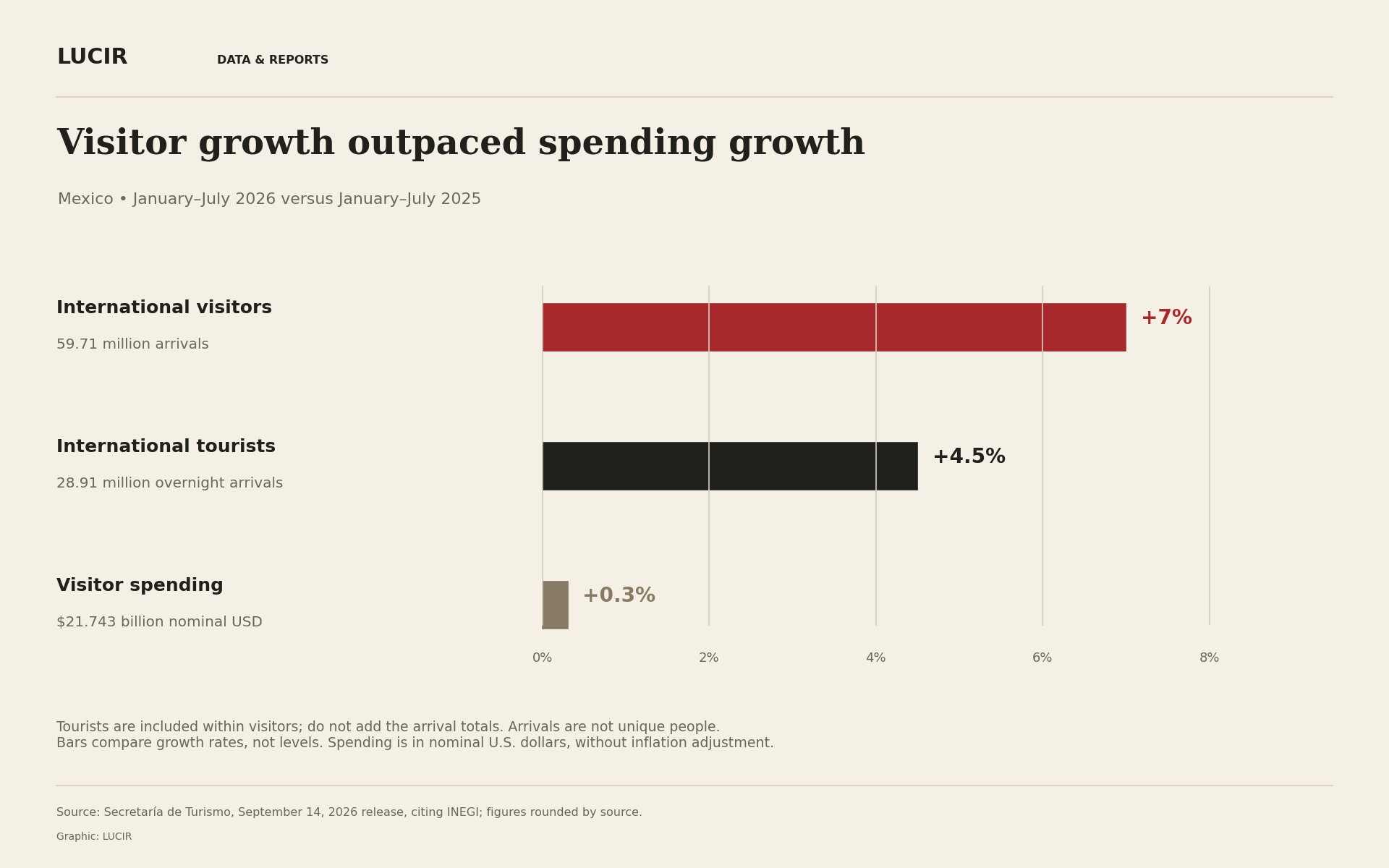
In a September 14, 2026 statement citing INEGI’s international-traveler survey, Mexico’s tourism ministry reported 59.71 million international visitors during January through July, 7% more than in the same period of 2025. Within that total, international tourist arrivals reached 28.91 million, an increase of 4.5%.
The ministry’s September 25 account makes the distinction explicit: the tourist figure refers to people who stay overnight. Readers should not rename the larger visitor total as overnight tourists. Nor should a count of arrivals be described as a count of unique people; returning travelers can generate multiple entries.
The spending series tells another part of the story. The September 14 statement reports $21.743 billion spent by international visitors in January through July, compared with $21.682 billion a year earlier, a reported increase of 0.3%. In that release, the increase in visitor volume is much larger than the increase in dollar spending.
That does not establish that every hotel, guide or restaurant took in less per customer. The composition of visits can change, and a national spending total is not an account of how receipts are divided among businesses. It is a reason to ask about the mix, not permission to invent a local answer.
There is also a data-navigation change worth knowing. INEGI’s tourism topic page says its older presentation covers August 2018 through December 2025. A new international-traveler statistical offering became available on March 11, 2026, with information beginning in January. Anyone building a comparison should follow the current program and its documentation rather than assume an old landing page remains current.
INEGI’s traveler-survey metadata places international visits outside the traveler’s usual environment and distinguishes them from travel to take employment with a resident entity. This is another reminder that tourism statistics have a defined scope. They do not measure every kind of movement across a border.
For coverage of Mexican cultural life, the next questions should reach the people making and hosting the experience. How are musicians, guides, food vendors and cultural spaces participating? What evidence would show that additional visits brought dependable income or pressure on local resources? Those questions need reporting from particular places.
The release supplies evidence of increased visitor and tourist arrivals over the first seven months. It does not settle the distribution of the gains. Reading volume, overnight stays and spending separately leaves room to investigate what a stronger tourism headline actually means on the ground.