Food coverage often needs a number small enough to fit in a headline. The risk is choosing one measure and asking it to stand for every difficulty a household faces. Enough dietary energy, dependable access to food and the quality of a diet are related questions, but they require different evidence.
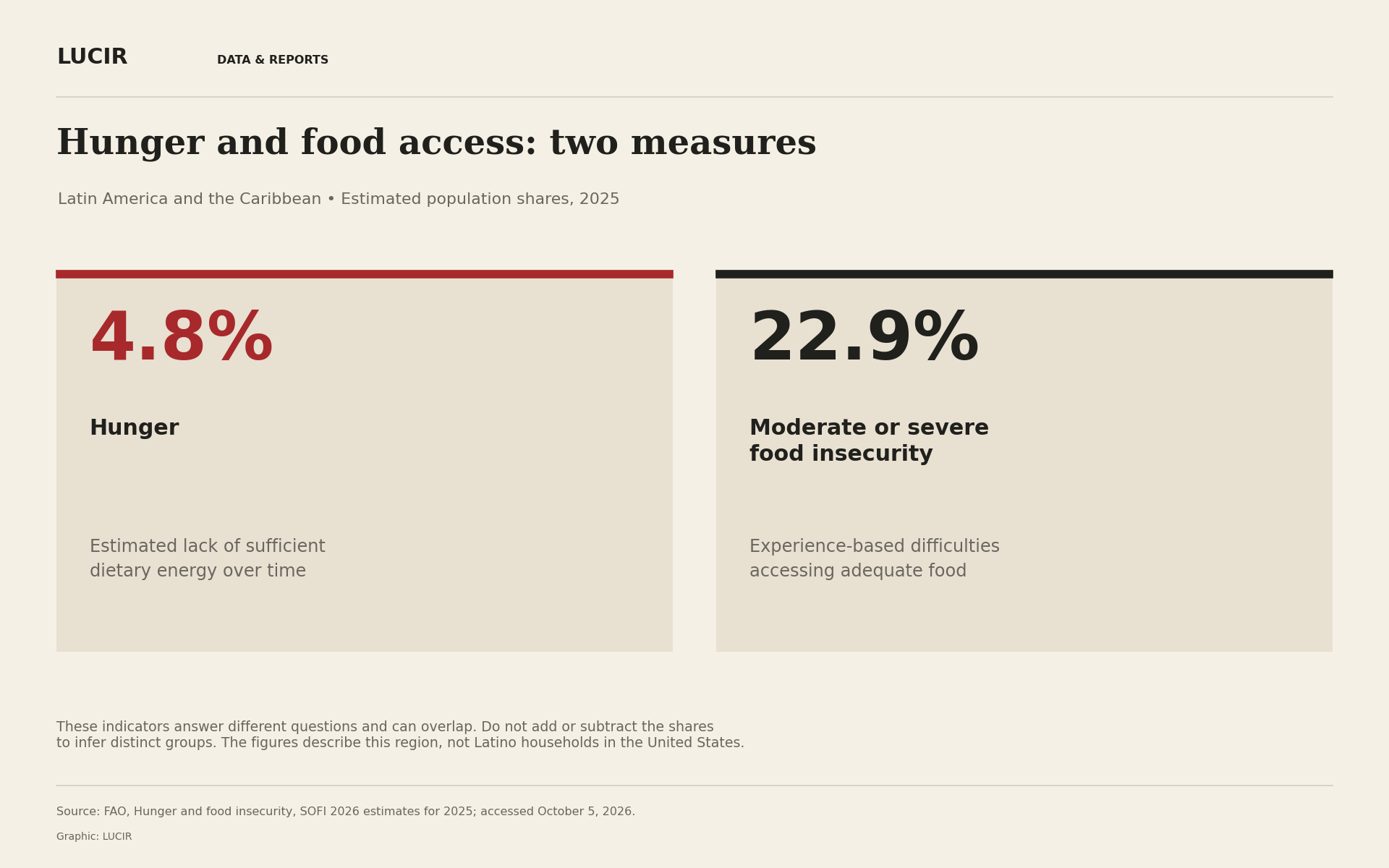
The UN’s 2026 State of Food Security and Nutrition in the World report was launched on July 21. In its current summary of the findings, FAO estimates that 32 million people in Latin America and the Caribbean faced hunger in 2025, or 4.8% of the region’s population. It also reports that 22.9% experienced moderate or severe food insecurity.
Those percentages should not be added together. They are different indicators describing the same broad regional population, not two disjoint groups. Nor does the gap mean that one measure has disproved the other. It means the questions have different scopes.
For global monitoring, FAO associates hunger with insufficient dietary energy for an active, healthy life. Its food-insecurity measure addresses constraints on access to adequate food. A headline using only the hunger estimate can therefore leave a reader without an account of the broader difficulty of obtaining food reliably.
The Food Insecurity Experience Scale draws on answers to eight questions about constrained access. FAO explains that the scale can produce estimates for individuals or households and can support comparisons after calibration. Its methodological FAQ is also explicit about a limit: this is not a direct measurement of actual food consumption, dietary quality or nutritional status.
For a newsroom, that means an interview about skipping meals can illuminate an experience without turning one person into a statistical stand-in for the whole region. It also means a photograph of a market stocked with produce cannot settle whether the people nearby can afford to shop there. Availability on a stall and access within a budget are separate reporting assignments.
Latino readers in the United States may recognize the importance of those distinctions when following conditions where relatives live. But the Latin American and Caribbean estimates are not estimates for Latino households in New York or the United States. Geographic connection does not make the populations interchangeable.
Local reporting could make the release more useful by asking what a family can purchase, how stable that access is and whose experience is missing from the available breakdowns. Answers should be documented for the place and period concerned rather than inferred from a regional average.
The report’s value is not a single verdict that a region is either hungry or secure. It is a framework for asking more exact questions. Keeping both indicators visible helps preserve the difference between measuring progress and assuming that everyone has reached a dependable table.