Money sent across a border can carry a rent payment, a birthday gift or help through a difficult month. A national remittance total cannot identify those purposes. It can, however, show why the number of transfers and the number of dollars should not be made to tell the same story.
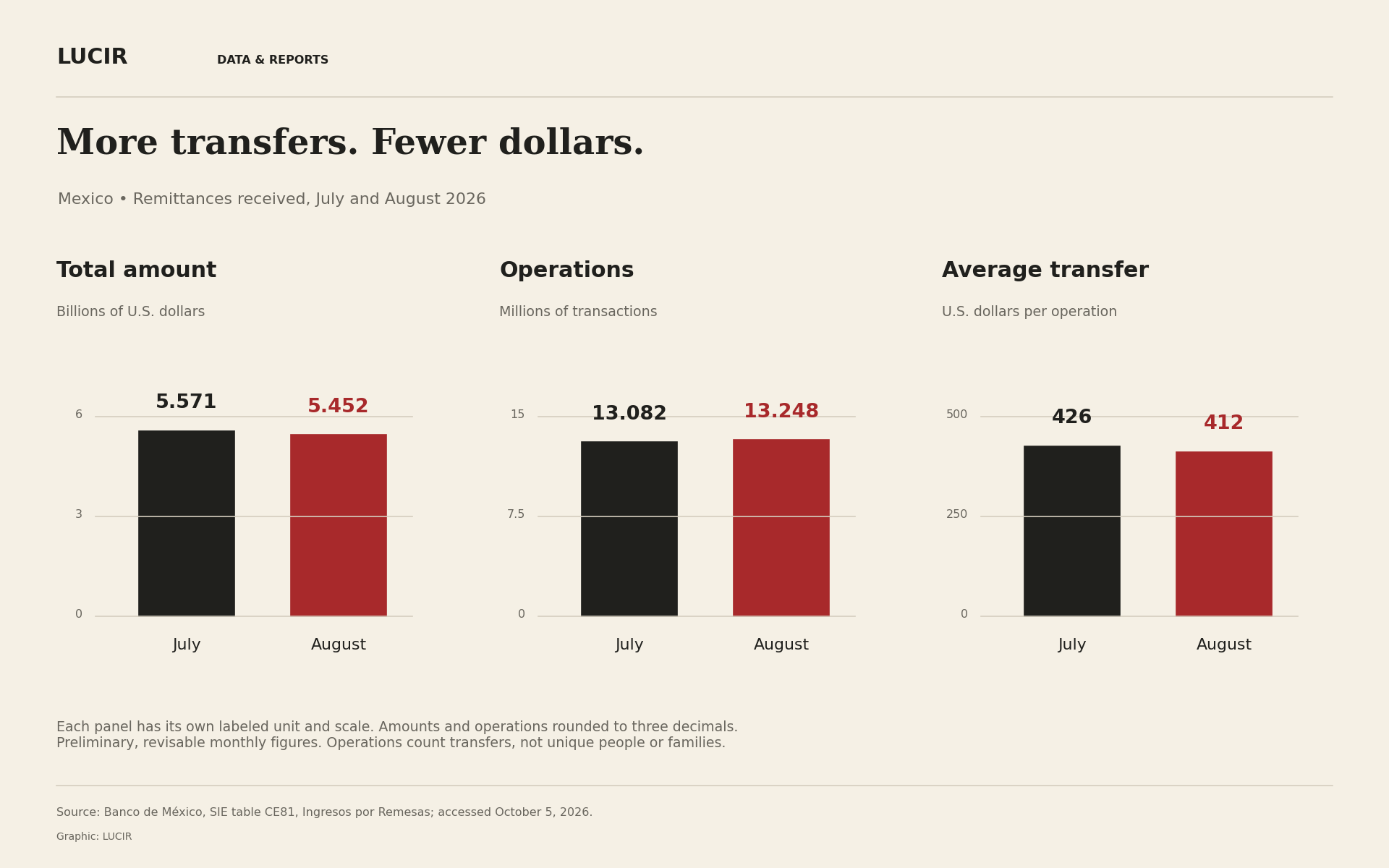
Banco de México’s CE81 series, checked on October 5, reports $5.452 billion in remittance receipts for August 2026, compared with $5.571 billion in July. The same table records about 13.248 million operations in August and 13.082 million in July. The monthly dollar total fell while the number of operations rose.
The table reports an average remittance of $412 in August, down from $426 in July. These are monthly observations, not a seasonally adjusted trend or a year-over-year comparison. Banco de México also marks the figures preliminary and subject to revision.
An operation is not a unique sender or recipient. Someone can send more than once, and a household can receive money from more than one person. The series therefore cannot be described as showing how many Mexican families received support. Nor does the lower average prove that every recipient received less.
That leaves an important reporting task between the national chart and the family budget. Was a payment divided into smaller transfers? Did the mix of senders change? Were there differences in the reasons for sending? These are possible questions for follow-up reporting, not explanations established by two monthly observations.
Another distinction appears at the point of purchase. The Consumer Financial Protection Bureau’s remittance explainer identifies the exchange rate, relevant charges and expected amount delivered as information to examine in a transfer. A dollar-denominated national total is not a receipt showing what one recipient obtained in local currency.
For a New York reader sending money to Mexico, the article’s most useful comparison is therefore between levels of evidence. The central bank describes a nationwide flow. A transfer receipt describes an individual transaction. A recipient’s budget describes what that transaction can cover. Combining those perspectives requires additional information; one cannot simply be read off the other.
The same care should apply to political explanations. A monthly movement does not by itself identify the effects of immigration enforcement, employment conditions, fees or exchange rates. Establishing a cause would require a comparison designed for that question and evidence beyond this table.
Remittance reporting should leave families room to explain their own decisions. A useful interview would ask how a payment fits into continuing obligations and what changed in the household budget. That testimony deserves to sit beside the statistics, with neither made to impersonate the other or judge the strength of family ties.