Who is going to hire the beginner? For a student trying to become the first professional in the family, that question matters more than another announcement about the future of work. The first paid assignment can bring a reference, a mentor and the confidence to pursue the next one.
A report published October 2 by the Partnership for New York City raises a warning about those opportunities. Its analysis finds fewer entry-level job postings across several occupations exposed to artificial intelligence. The report’s table puts the decline in annual entry-level postings for design, media and writing at 40.6%. That reaches directly into the creative careers LUCIR covers.
We should be precise: fewer advertisements do not equal the same number of people laid off. The report does not isolate how much of the decline AI caused or provide a Latino job-loss count. Exposure measures the potential for technology to change tasks; it does not mean every exposed job will disappear.
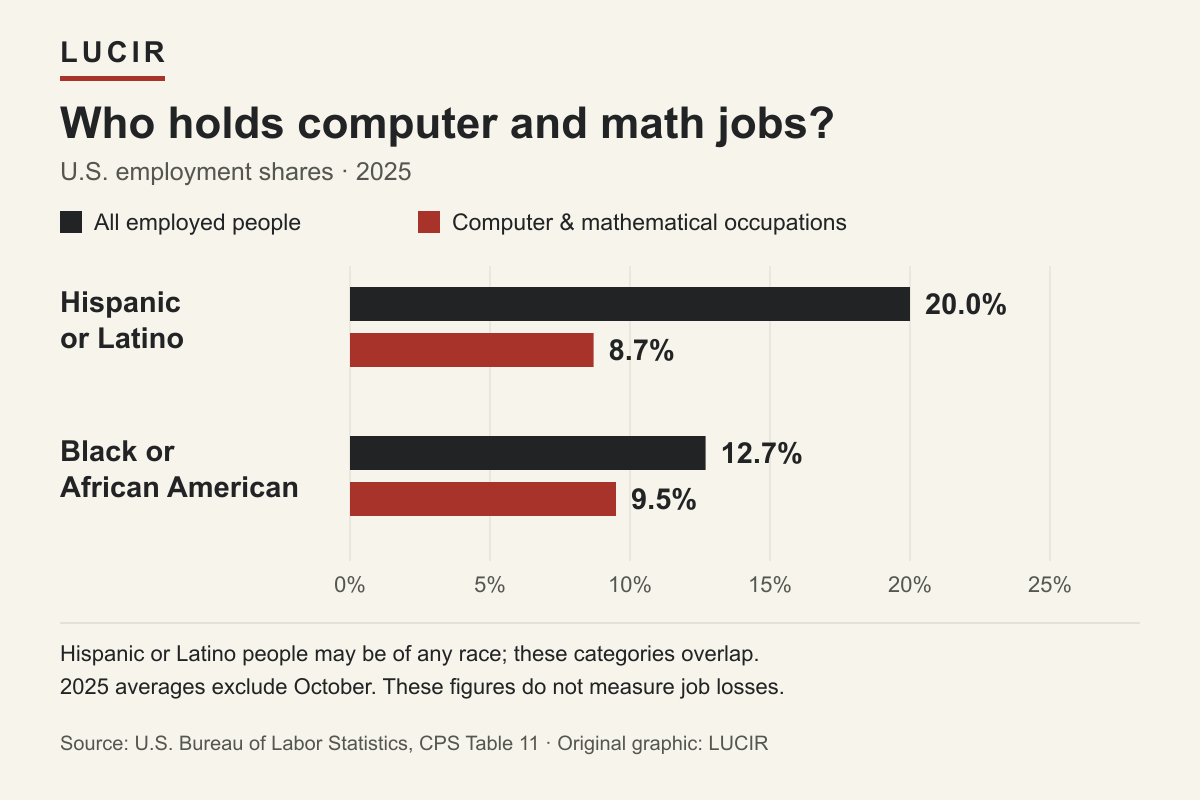
For Latinos nationally, one concern is entering the occupations where these tools are built and applied. In Bureau of Labor Statistics estimates for 2025, Hispanic or Latino workers represented 20% of all employed people but 8.7% of workers in computer and mathematical occupations. Black workers accounted for 12.7% and 9.5%, respectively. These are national employment shares, not New York estimates or measures of AI displacement. The 2025 figures average eleven months, excluding October’s shutdown-related collection gap.
The patterns differ across communities: Asian workers held 25.2% of computer and mathematical jobs and 7.5% of employment overall. Nor are Latino and Black workers two separate populations: Latino people can be of any race. Afro-Latino workers belong in both conversations. Aggregate figures cannot tell us the experiences of Indigenous Latinos, individual national-origin communities or everyone grouped under “people of color.” Coverage and policy need that detail.
Access begins before an interview. New York’s March 2025 Digital Equity Roadmap, drawing on 2023 census survey data, estimated that about 30% of city households lacked the combination of mobile and home broadband. That does not mean all lacked internet entirely. It does mean that telling everyone to learn online overlooks the conditions required to do it.
There are possibilities worth pursuing. A small business might use these tools to organize invoices or prepare a first draft of marketing material. A worker might spend less time on repetitive paperwork. But these are potential uses, not proof of higher wages or secure employment. Who checks the output, owns the work and receives the savings should be part of the decision.
New York should make paid apprenticeships, employer-funded training and accessible community learning part of its response. Training should fit around work and caregiving, offer language support where needed and lead to demonstrable opportunities. Employers should report who gets hired, retained and promoted, with race and ethnicity measured carefully. A course-completion total alone cannot answer those questions.
Across the country, the lesson is to examine local hiring and access rather than apply New York’s numbers everywhere. Our concern, as César Vargas has argued about representation, is what the numbers let people do. Latino workers should help design the training, negotiate the terms and share in the gains. A future that requires experience must still give people a fair chance to earn it.