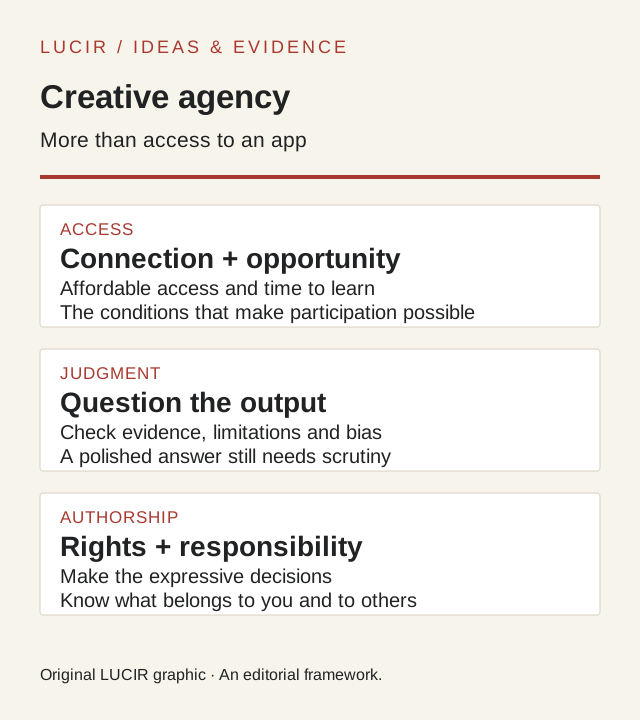
Artificial intelligence is arriving with the familiar sales pitch: a tool that will make everyone faster, smarter, and more creative. Fine. But a society does not become fair because more people can open the same app. The real question is who can understand what the tool is doing, question its output, protect their work, and turn it into something that serves a life beyond the platform.
That is why AI literacy cannot mean a weekend of prompt tricks for people who already have reliable internet, paid subscriptions, and time to experiment. A 2024 NTIA report, citing the Government Accountability Office’s 2022 findings, describes more than 100 federal broadband programs alongside millions of Americans still without broadband. The problem includes deployment, affordability, devices and digital skills. Access remains material. A person cannot build creative agency on a connection that is absent, unstable, or too expensive to use freely.
But a connection alone is not agency either. UNESCO’s AI Competency Framework for Students organizes learning around a human-centered mindset, ethics, AI techniques and applications, and system design. Its progression moves from understanding to applying to creating. That is the right direction. We need people who can ask what a system is trained to reward, what it cannot know, where bias and error enter, and when an answer needs a human source instead of a confident machine voice.
For creators, the stakes are especially direct. The U.S. Copyright Office’s 2025 report says using AI as assistance does not by itself bar copyright protection for a larger human-authored work. It also says prompts alone generally do not establish enough human control over expressive elements for protection. That is not a reason to panic or to dismiss the technology. It is a reason to take authorship seriously. A creator should not be reduced to someone who shakes a vending machine until content falls out.
Communities that have spent generations fighting to be seen cannot afford a new version of the same arrangement: our images, voices, stories, and labor become raw material, while somebody else owns the infrastructure and collects the reward. AI access has to include the ability to make informed choices about data, attribution, rights, and the final edit. It has to include libraries, schools, community organizations, and workplaces that teach people how to investigate a claim, document a source, revise a draft, and recognize when a polished output is hollow.
There is no virtue in pretending this technology will disappear. There is even less virtue in allowing the people with the least access to shape it to be told they must simply adapt. The work is to build capacity with standards: broad access, clear rights, human accountability, and room for people to create rather than merely consume. That is digital literacy worthy of the name. It gives people more than a tool. It gives them a say in what the tool is allowed to do to them, with them, and for them.