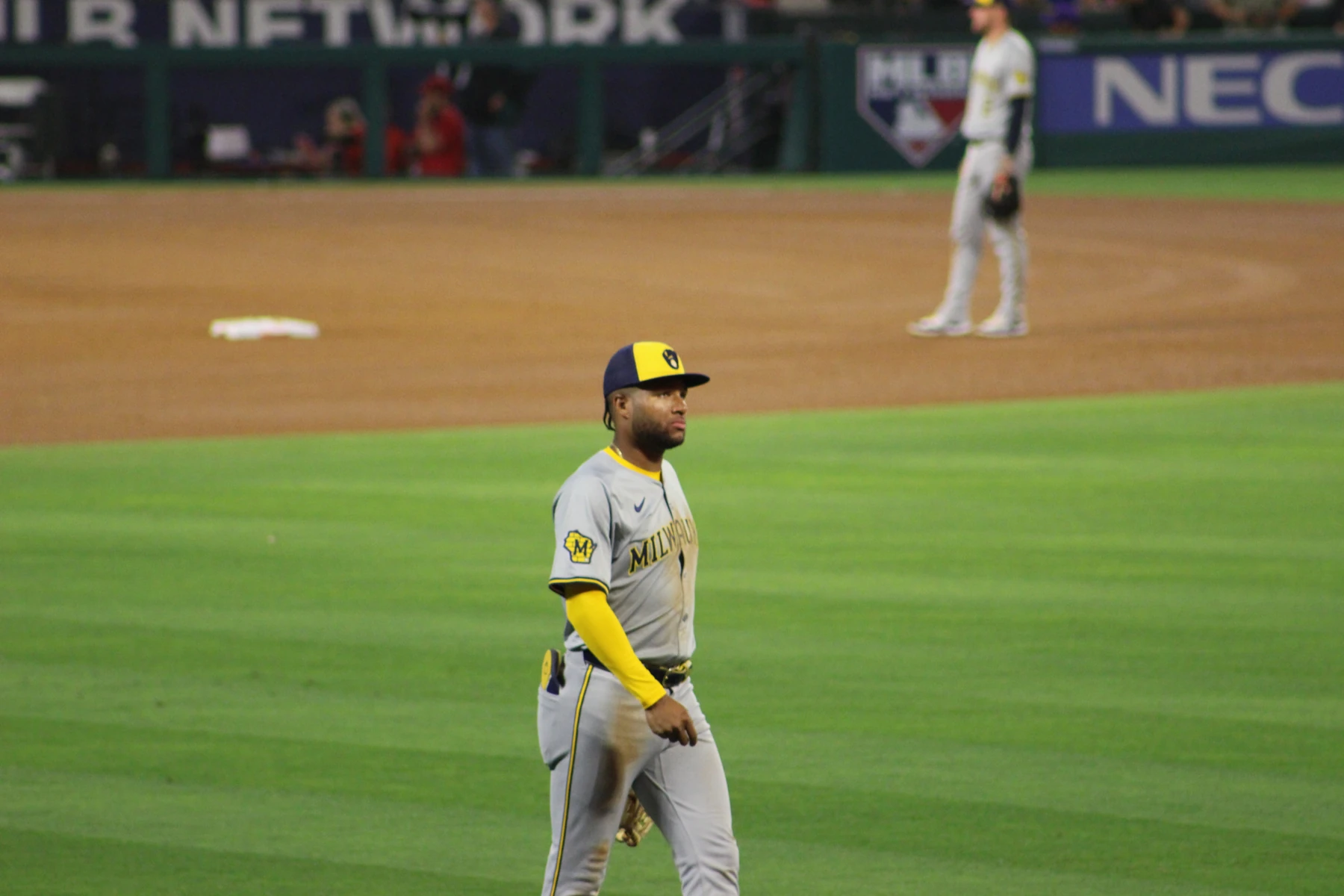

Jackson Chourio’s walk-off single beat San Diego 4–3 on October 4, giving Milwaukee a 2–0 NLDS lead, according to MLB’s report. The result invites an instant legend. The more useful question is what a dramatic October contribution can tell us about a young player, and what it cannot.
Chourio is 22, born in Maracaibo, Venezuela. His official player record lists a 2026 major-league season with a .291 batting average, 25 home runs and 23 stolen bases. Those numbers locate his value across several kinds of offensive work. A pitcher has to account for the extra-base threat; a defense also has to account for movement once he reaches base. A stolen-base total also leaves something out: opportunities and outs matter. Raw totals are a starting point for evaluating baserunning, rather than a complete assessment. One swing provides a memorable image of a player whose season cannot be reduced to one skill.
The development biography begins with a different position: Milwaukee signed him as a shortstop in January 2021. He subsequently moved to the outfield and was named Carolina League MVP in 2022. That sequence matters because prospect development involves revision. The job a teenager is recruited to do may change while his talent is being evaluated. A successful arrival can conceal those adjustments when the career is retold backward from its most visible moments.
There was an interruption this year, too. The transaction log records a left-hand fracture, an April rehabilitation assignment and activation on May 4. The season line belongs beside that chronology. It describes production accumulated after time away, without explaining how the player experienced the injury or supplying a medical account of his recovery. Those are questions statistics alone cannot answer.
The temptation in October is to turn a small sample into a personality test. A decisive hit becomes proof of permanent composure; a failure becomes evidence that someone cannot meet the moment. Neither judgment is a sound way to understand development. The regular season gives a broader view of repeatable contributions, while a postseason game shows what happened under a particular set of circumstances.
For Venezuelan baseball followers, the attraction here is specific: a player from Maracaibo has become an important part of Milwaukee’s present. There is no need to make him represent every Venezuelan career, or to predict the rest of this postseason, to recognize the achievement. The longer record allows the highlight to remain thrilling without asking it to explain everything.