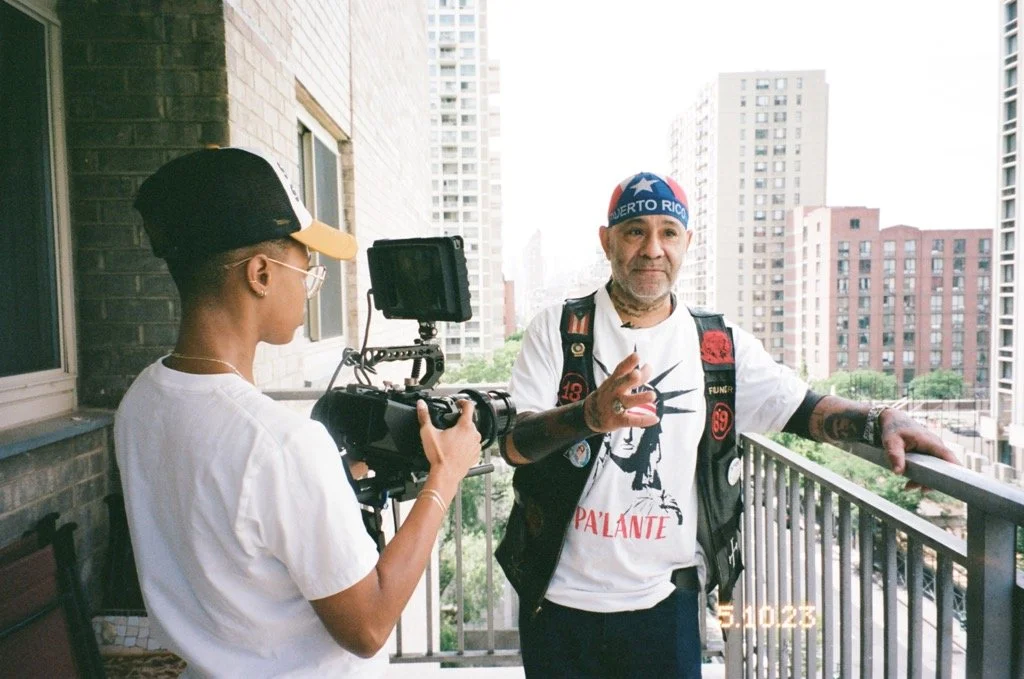
A Puerto Rican flag can travel around the world in a music video. The people who fought for what it represents deserve to travel with it. Their names, their work, their stories.
I know Chino. We talk often, and the man is a wealth of stories, courage and conviction. To me, he is a giant whose measure is the people he brings together: a peacemaker, a community builder, someone who understands that justice has to mean something in the lives of your neighbors. You can admire a photograph of him and still miss how much he carries. That is why I want people to know the person behind the image, and the communities that give his work its purpose.
On Manhattan’s Upper West Side, he is the “godfather” of La West Side Familia, a Puerto Rican-led motorcycle crew and community group whose history reaches back to the 1970s. His life connects housing struggles, Puerto Rican liberation, neighborhood culture and the stubborn work of keeping a community present while the city around it changes. Filmmaker Taylor Hosking describes that broader significance in her statement for The Gotham.
Now her documentary, West Side Familia, gives that history room to speak.
West Side Familia screens at the Bushwick Film Festival on Saturday, October 10, 2026, from 2:30 to 4:15 p.m. (New York time), at Williamsburg Cinemas, Theater 6, 217 Grand Street, Brooklyn, NY 11211. The official screening listing currently marks it sold out, with rush-line access only; check that listing for the latest admission details.
The flag, and the fight behind it
According to the film’s official account, Chino participated in squatters’ rights and Puerto Rican liberation movements, with ties to the Black Panthers and Young Lords, and joined a Statue of Liberty takeover. These are the filmmakers’ account of his history, an important distinction when reconstructing a life whose record lives partly in people’s memories.
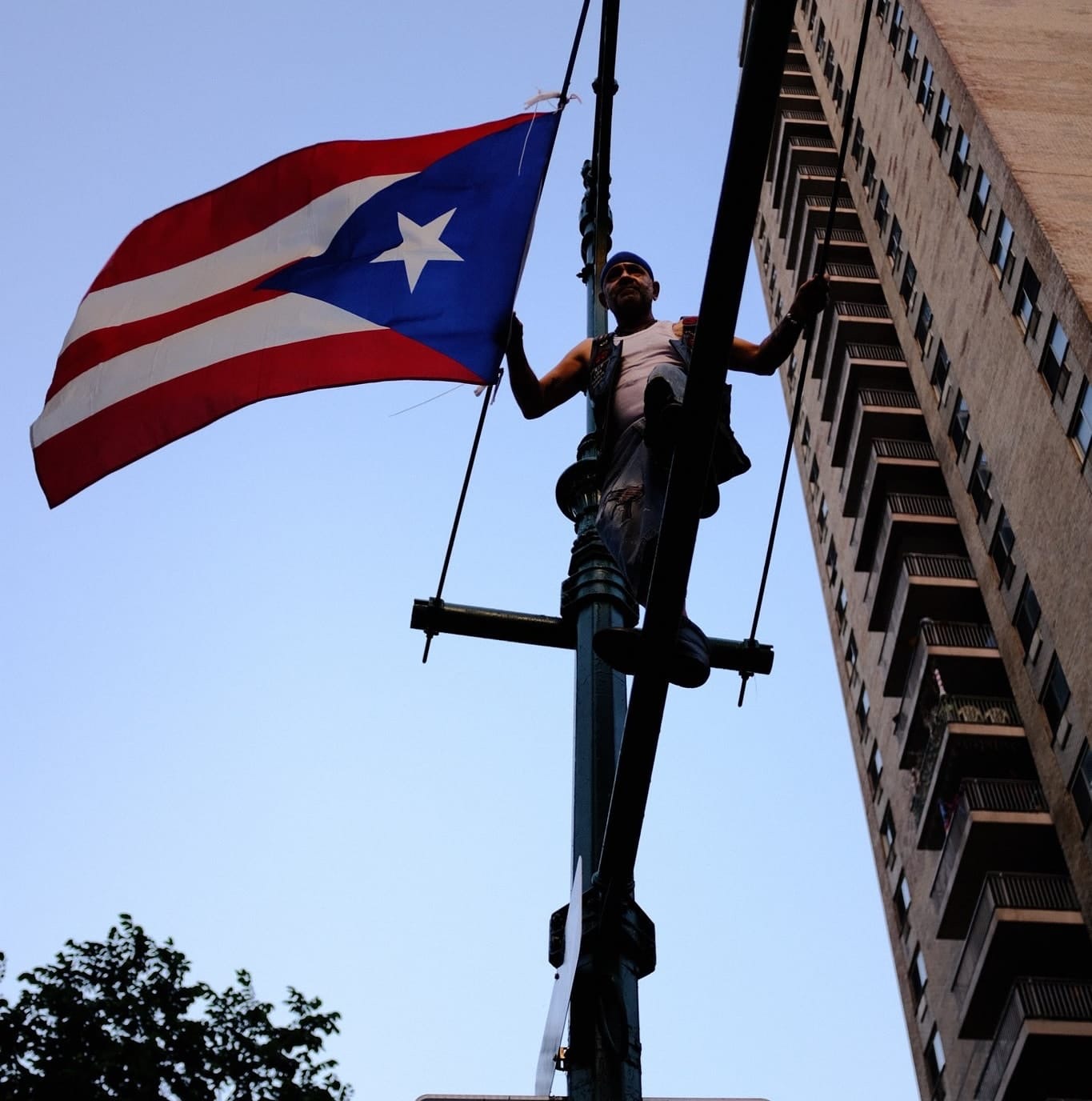
That history has renewed visibility through Bad Bunny. At a CUNY discussion, historian Jorell Meléndez-Badillo, who worked on the DeBÍ TiRAR MáS FOToS visualizers, explained that the Statue of Liberty imagery associated with “NUEVAYoL” evokes the monument’s occupations by Puerto Rican nationalists in 1977 and 2000. CUNY’s account places the image within a much longer history of diaspora and political resistance.
The spectacle brings attention. A profile like this should help that attention find the people.
A neighborhood is somewhere people live
The film’s account also describes Chino’s prolonged fight against a proposed fence around the plaza where his group gathered. La Familia’s activities include neighborhood cleanups, advocacy for places where young people can gather, and traditions honoring people the community has lost. Those details matter. They make community care something you can recognize in someone’s working day.
Who gets to gather? Who gets treated as a threat? Who gets to remain visible after the neighborhood becomes desirable to somebody else?
In Daniel Parra’s interview for City Limits, Hosking describes the friction between longtime residents and newcomers. She also points to common ground: people want safety, respect and a place where they belong. Recognizing the neighbors already doing that work would be a useful start.
He has had something to say about the pictures, too
Chino told VICE in 2019: “West Side Story didn’t show what was really going on.”
There is a reason to revisit that criticism alongside this documentary. Who gets to describe a neighborhood shapes what everyone else thinks they know about it. Hosking grew up there, yet making the film revealed histories she had never been taught, including the local housing activism and cultural movements she discussed with WHYY.
Chino’s voice also exists on record, literally. ELKAT Productions credits his vocals on “The Godfather,” released in 2018. Apple Music also lists him among the featured artists on “La West Side Familia Reprise,” from the group’s 2014 album, 13. Those credits add another dimension to a man too easily reduced to a striking photograph.
And the work continues
At a BlackStar screening discussion reported by The Triangle, Chino explained the reassurance the neighborhood flag offers older residents. He also asked about the future of the tradition after passing it to his nephew.
That is the question underneath the portrait: who carries the work forward?
Chino embodies the spirit of LUCIR: bringing people together, standing up for one another, and making room for our people to live and thrive. I’m glad to see him getting his flowers. His story deserves to keep being told through film, photographs, music, writing and the conversations that carry it forward.
We owe gratitude to the people who helped make a place for us in this world. People who fought so we could navigate it, exist in it, and imagine something beyond merely getting through it. That gratitude should have some work behind it: learning their names, giving them credit, listening while they’re here, and carrying forward what they helped make possible. Chino has given so much of himself to that work. His story belongs in our present, and in whatever future we’re serious about building.