Everybody has advice for people who have been lied to. Check the source. Read beyond the headline. Do your own research.
Fine. Who is going to gather the records, question the officials, interpret the studies, and explain what all of it means? Who has the time? The training? The access?
And who is going to pay them?
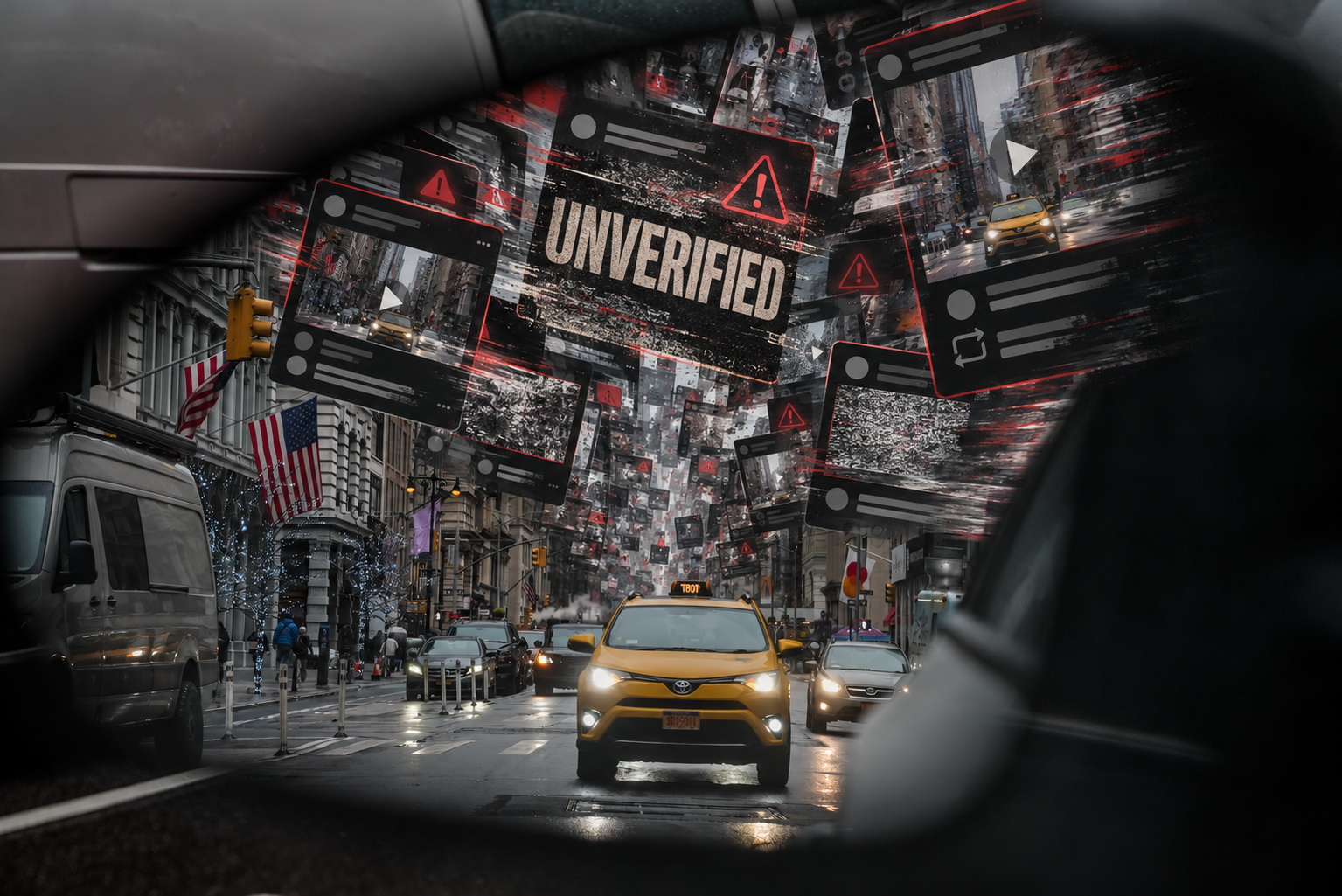
Social media has supercharged the cesspool. A reported story, a fabricated image, a paid endorsement dressed up as somebody's spontaneous revelation, and some blowhard's confident nonsense can reach you in the same minute. Add AI slop that keeps getting more convincing, harder to detect even with the sharpest eyes, and now you have to determine whether the person, place, or event even exists before getting to whatever they're trying to sell you.
Take the AI-manipulated Facebook video that made Brazilian soccer legend Ronaldo Nazário appear to endorse an online gambling game. It promised earnings greater than those of teachers, bus drivers, or grocery workers. More than 600,000 views. More than 50 user reports. One person's report and appeal weren't prioritized for human review. Meta disabled the advertisement but left the original post up until the Oversight Board selected the case. These are the findings in the Board's June 2025 decision.
People saw the problem. They reported it. They used the system they were given. The post stayed up until outside scrutiny made it somebody's priority.
So much for putting the responsibility on the user.
I also work in media, social media, new media, if I may. I have spent years criticizing it, too. I know how quickly a conversation about protecting journalism becomes a campaign to preserve the same people, institutions, and arrangements that have kept Black and Brown voices out.
It’s my duty as a writer and storyteller to find the truth, follow the data, and build my arguments from what I uncover. That includes asking uncomfortable questions about people and institutions we’re told to trust.
We are expected to defend an industry that has misrepresented us, appropriated our observations, and treated our knowledge as something to extract rather than something worth paying for. And when we publish independently, we're expected to compete with entire teams on whatever money and energy we have left.
Who gets to explain the world to us? Who can afford to keep doing it? Who gets punished for challenging the explanation? Those questions belong in every serious conversation about misinformation.
Who watches the watchdogs?
On September 10, 2026, the Oversight Board addressed Meta's planned Community Notes testing in 16 Latin American countries. It called for country-specific risk assessments, evidence about the U.S. program, and researcher access. It also warned against treating notes as a direct replacement for fact-checking, which the notes themselves often depend on.
A correction needs something to cite. Somebody has to produce the reporting, documents, or research behind it. Moving the final explanation into a volunteer's hands doesn't make that work free.
I asked this in my 2022 essay about TikTok and the changing digital landscape. I followed the relationships between platforms, advertisers, media, and government, and questioned whose interests were being protected. Those questions apply to the Oversight Board, government watchdogs, newsrooms, and independent commentators, too. What happens when the people paying the bills become the subject of scrutiny?
Who controls the microphone?
In my 2022 essay on disinformation and misinformation, I called for serious investment in independent voices working for the material well-being of historically marginalized people. We were expected to fight well-funded narratives with whatever resources we could spare, and make ourselves agreeable to get even that little support.
The money was already there for people spreading falsehoods. I linked Jane Mayer's reporting on the financing behind the 2020 election lies, which documented wealthy backers sustaining the campaign to discredit the result.
Soccer is not the opium of the masses. Disinformation is. Except it’s not making us catatonic. It’s making us go for each other’s throats.
People were paying to keep the lie alive. Meanwhile, independent Black and Brown writers, researchers, and creators are told to build a following, be consistent, prove our value, and finance it ourselves. We can bring the knowledge, the work, and the audience and still find somebody moving the requirements for entry.
The government has helped determine who gets to own that audience, too. In 1995, Bill Clinton signed legislation repealing a program that helped minority-owned businesses acquire broadcast stations. A year later, he signed the Telecommunications Act, opening the door to greater corporate consolidation. A tool for broadening ownership disappeared while large companies gained room to accumulate stations. Who controls the microphone is decided long before a journalist asks a question. This history runs through both parties.
Who controls the microphone is still being decided. In January 2026, TikTok’s U.S. restructuring put moderation and responsibility for retraining its recommendation algorithm in a joint venture whose managing investors include Oracle, Silver Lake, and MGX. That reaches into how our work finds an audience and who gets to set the rules.
On October 6, Paramount completed its takeover of Warner Bros. Discovery. Studios, news networks, and streaming platforms, gathered under the same corporate roof. I wrote about Hollywood’s hostility to Latino talent in my recent essay. We were already fighting for financing, ownership, meaningful roles, and the authority to tell our own stories. Now more of those decisions sit in fewer hands. Who gets commissioned? Who gets distributed? Who gets to keep working?
Inside those institutions, access comes with its own conditions. In "Nowhere to Turn to but Social Media" in 2020, I challenged mainstream media's gatekeepers and the well-funded independent outlets reproducing the same racial hierarchies. We were supposed to be grateful for access, even when it meant making our rhetoric comfortable for the people in charge.
The Pew research I cited found that 77 percent of newsroom employees were non-Hispanic white, compared with 65 percent of workers overall, using 2012–2016 Census data.
Even the people chosen to document us and cover our communities had to arrive carrying privilege: the complexion, credentials, connections, or money that made the gatekeepers comfortable. I wrote about that imbalance in my earlier essay on privilege. A shared label can conceal a world of unequal access. We can supply the stories, the suffering, the audience, and still be left outside when the jobs are handed out.
In the follow-up, I wrote about the blind spots privilege produces and the respectability that gets certain people through the door. Those blind spots become editorial judgment. Someone else's comfort gets mistaken for fairness. Our anger becomes the problem, our exclusion a footnote. I have written about my own advantages, too. What does our access allow us to do for the people still kept outside?
Even within Latinidad, nationalities have their own hierarchies of visibility and access. Look at the leadership. Who gets to be the face? Who is nowhere to be found? Look, too, at the spaces they share with other marginalized people. Some leaders don’t see, or don’t care, that people who look like them are being mistreated. Under white supremacy, hierarchies and visibility sometimes cross paths. People can occupy the same level and still fight for their own interests, even when the companies they represent work against the communities they claim to champion. Sharing a space or a struggle doesn’t mean we’re looking out for each other.
And sometimes our own do more than distance themselves. They become corrosive to us, withholding support or treating us more harshly to prove to somebody else that they show no favoritism. What a grotesque entrance fee: make your people pay for your acceptance. That danger runs through Between Two Swords: The Dangers of White People Choosing our Reps. We have to ask whose approval our representatives are protecting, and whose humanity gets ground down in the bargain.
We aren’t between a sword and a wall. We’re surrounded by gun barrels pointed at us. Every prejudice, every form of discrimination, every bias, including those cultivated within our own communities, adds another barrel to the circle. Sometimes they take turns. Sometimes they all fire at once.
Then we're told to go independent. Publish it yourself. Build your own platform.
And when we do?
In June 2020, Black Zebra Productions, a Black-led independent journalism outlet, posted video documenting police violence against Sacramento protesters. Two days later, Facebook deactivated its entire page. The ACLU demanded answers. According to its account, Facebook refused to explain the removal when it met with Black Zebra and the organization.
An entire independent outlet's page. Think about the reporting, the relationships, and the access to an audience that can disappear with it.
A 2023 study based on interviews with 12 Black TikTok creators documented creators’ accounts of shadowbanning, unwarranted violations, and removals. One participant checked from a separate personal account and couldn't see their own post. Creators described discovering that their work was invisible to others without receiving a violation notice.
So now, besides researching, writing, recording, editing, and trying to get paid, you have to investigate whether people can even see what you've published. You have to appeal decisions, explain yourself, and keep producing while the platform controls access to the audience.
The people who can challenge misleading portrayals of our communities need the means to reach us. They need support that survives an uncomfortable opinion, an angry donor, or a confrontation with a platform owner. Otherwise, we're financing obedience and calling it independence.
Taking away the people who do the work
And the places where we have managed to work keep disappearing or losing resources. English-language Latino journalism has been through this over and over. I wrote for HuffPost’s Latino Voices. These were places where our stories could receive sustained attention, where somebody knew whom to call and what questions to ask.
In January 2014, NBC Latino’s standalone operation closed, with four of its seven staffers dismissed and the others reassigned. Latino coverage moved into NBCNews.com. VOXXI stopped producing news in March 2015, after its funding and staff had dwindled. Hispanic Link stopped publishing that year when its founder retired, taking a reporting operation and training ground for young journalists with it. Fox News Latino’s standalone site was folded into FoxNews.com in December 2016.
ABC and Univision launched Fusion for English-dominant Latino audiences in 2013. Its digital newsroom went through cuts and became Splinter in 2017. The Fusion television channel closed at the end of 2021, as Univision renewed its focus on Spanish-speaking audiences.
At HuffPost, a former Latino Voices editor was laid off in January 2019. Latino Voices later continued within a broader, relaunched Voices operation. A name can survive while the people who built its coverage have to find work somewhere else.
In October 2023, Futuro Media publicly announced that Latino Rebels would stop publishing new stories because of financial difficulties. The Los Angeles Times had just launched De Los for English-dominant Latino readers that July. Six months later, layoffs cut deeply into its team. Think about how little time those journalists had to build something before so many of them were shown the door. The cuts reached the Times’ Spanish-language operation, too: it lost staff in 2023 and its editor in January 2024.
The retreat has reached other communities, too. CNN disbanded its race and equality team in July 2024 and reassigned its reporters. In October 2025, NBC dismantled the dedicated teams behind NBC Latino, NBC BLK, NBC Asian America, and NBC OUT while retaining the sections. That same month, CBS eliminated its Race and Culture Unit.
I know so many journalists, photographers, and other media workers who have watched their livelihoods go poof. Years of work, relationships, and expertise, and suddenly they’re the ones trying to figure out how to keep going.
A company can keep the name on its website while taking away the people and resources that made the coverage possible. Who remembers the history? Who has the relationships? Who has time to notice what everyone else has missed?
The losses extend across local journalism. Medill's 2025 State of Local News report found that nearly 40 percent of local U.S. newspapers had disappeared over two decades. It identified 212 counties without a local news source and another 1,525 with only one remaining.
Public support has been withdrawn as well. At Trump’s request, Congress rescinded roughly $1.1 billion in previously approved funding for the Corporation for Public Broadcasting for fiscal years 2026 and 2027. Trump signed the measure on July 24, 2025, cutting support for the public-media system that includes NPR, PBS, and local stations.
Then there is access to the people exercising power. In September 2026, Trump barred CNN, MS NOW, and Politico from the White House over coverage he denounced as false. A judge ordered their access restored and, on October 8, extended that protection through October 13. Journalists having to fight in court to get back into the places they cover. Public media having its funding pulled out from under it. We are under attack, and so is the public’s ability to scrutinize its government.
The need for information didn't disappear with the money. In a Medill survey published in February 2026, 51 percent of daily local-news consumers surveyed in news deserts said they relied on non-journalistic sources, including social media groups, influencers, friends, and family.
Somebody still has to examine the school contract, obtain the records, and follow up when the public official's explanation doesn't add up. A busy feed can conceal a great deal of missing work. The investigation nobody could afford to assign never gets a headline.
Who do we turn to?
These are perilous times. It was bad for us before. Now we're knee-deep in it, and there's no bottom.
There are plenty of charlatans selling supplements, snake oil, and pipe dreams, with little oversight and plenty to say about the institutions that have mistreated us. Pyramid schemes. MLM pitches dressed up as financial freedom. And some of what they say is true. That’s how they get us. We don’t fight institutional discrimination and exploitation by sending our folks down another rabbit hole that will suffocate them faster. We have every reason to question those institutions. We must also question the people using our distrust to sell us whatever they’re peddling.
Fraud losses reported to the FTC reached $15.9 billion in 2025, up from more than $12 billion in 2024. Reports rose from 2.6 million to 3 million. In its review of 70 MLM income disclosures, the FTC found that the vast majority of participants received $1,000 or less a year from the companies, generally before expenses. People trying to make ends meet are being sold another way out.
So now, who do you trust? A charismatic charlatan or institutional malice? It’s a jungle.
Some of what I hear from Latin American podcasters and influencers sounds painfully familiar. I heard versions of it in English ten or twenty years ago. Now the podcast bros are serving it up in Spanish with the confidence of people who think they've discovered something. The imitation is palpable, and the impact is just as catastrophic, if not more so.
Spanish-language media is beholden to the same owners, advertisers, political interests, and hierarchies. Changing the language doesn’t free us from the people paying for the narrative.
Misinformation behaves like a drug-resistant virus. It survives correction, changes its packaging, and keeps spreading. We have to keep finding new ways to treat it. A debunking in English isn’t going to magically reach the person consuming the repackaged lie in Spanish. Somebody has to recognize it, trace it, explain it, and find a way to reach the people being fed it.
Again, who is paying those people?
You turn to uncompromising professionals and educators. People willing to follow the evidence and tell you what they find, even when it costs them. They were underfunded and maligned before. Now they’re fighting their own war, their own decimation. And we’re still asking them to help us find our way through this.
I remember learning eons ago in sociology class how despots, dictators, and fascists go after professors, students, and the people who teach us to question power. In Nazi Germany, the purge of Jewish and politically disfavored university faculty began in 1933. After Chile’s 1973 coup, the University of Chile lost its autonomy and dismissed teachers, researchers, and creative practitioners. History, philosophy, the arts, the humanities: what happens when the people preserving memory and teaching us to examine it are pushed out?
Does that not ring a bell to you? Let me know so I can ring it again.
The Department of Education's inspector general reviewed changes beginning in early 2025 and documented a workforce reduction of at least 40 percent. Its June 2026 report identified education studies among the highest-value terminated contracts, some apparently required by law. It recorded reversals of some terminations and limits on its own access to department information.
The department's enacted fiscal 2026 discretionary funding was slightly above the previous year's level. Meanwhile, look at its capacity to use that funding: staff lost, research interrupted, investigators unable to obtain information. The work requires people. You cannot replace them with a number on a budget sheet.
And when politicians turn support for marginalized people into a fight over initials, look at who loses their office and who loses the person they could turn to. In June 2025, Wright State University announced that complying with Ohio's new law meant discontinuing its Asian and Native American Center, Bolinga Black Cultural Resources Center, Latino Center, LGBTQA Center, and Women's Center, along with associated staff positions. Disability-center functions were reassigned elsewhere.
Those dedicated staff carry knowledge and relationships built over years. Black and Brown students, other people of color, women, and LGBTQ students lose people who know their communities and can help them navigate institutions. A promise of inclusion does not staff an office.
Children and older adults need people they can turn to, too. GAO's May 2026 review of Tribal Head Start documented longstanding communication failures and uncertainty around recent agency changes. One program said delays limited its ability to raise teacher pay. The FTC's 2025 report on protecting older adults described investment scams often reaching people through social media.
The consequences reach into classrooms, homes, and people's savings. Telling everyone to be more careful while weakening the places they can go for answers is a hell of a way to claim you're looking out for them.
We are the last ones in and the first ones out. And the damage reaches beyond a newsroom. In 2025, the share of Black women with jobs dropped 1.4 percentage points. Latinas lost ground on pay, too. Counting everyone with earnings, including part-time and part-year workers, their median annual earnings came to about 53 cents for every dollar earned by white, non-Hispanic men, a wider gap than the year before. Black women and Latinas are pillars of our families and communities. Now those pillars are being left to fend for themselves. This is when we step in, support their work, and help them back up.
Pay for the work
In my 2024 call for a community digital-literacy initiative, I proposed expert-led workshops, culturally relevant educational resources, and support for the people doing that work. It takes labor to help people navigate this mess. Fairly paid labor.
Trust has to be earned. Show us the evidence and the funding. Correct your errors. Answer to the communities whose lives you’re discussing. And give independent voices the resources to do that work without demanding obedience in return.
Platforms must answer for their enforcement decisions and give independent researchers meaningful access to examine them. Public institutions need the staff and resources to produce knowledge and serve the people depending on it. Those of us in media have to show our work, correct our errors, and follow the evidence even when it makes our own patrons uncomfortable.
And people with money need to stop treating all of this as somebody else's charitable obligation. Fund local reporting. Support independent Black and Brown journalists, researchers, educators, and creators. Form alliances, share expertise, and stop hoarding opportunities. Give people the resources to investigate, publish, distribute, and keep going without requiring their gratitude to take the form of silence.
We cannot keep demanding a better-informed public while making reliable information harder to produce and the people producing it easier to discard.
The truth takes work. Who is willing to pay for it?