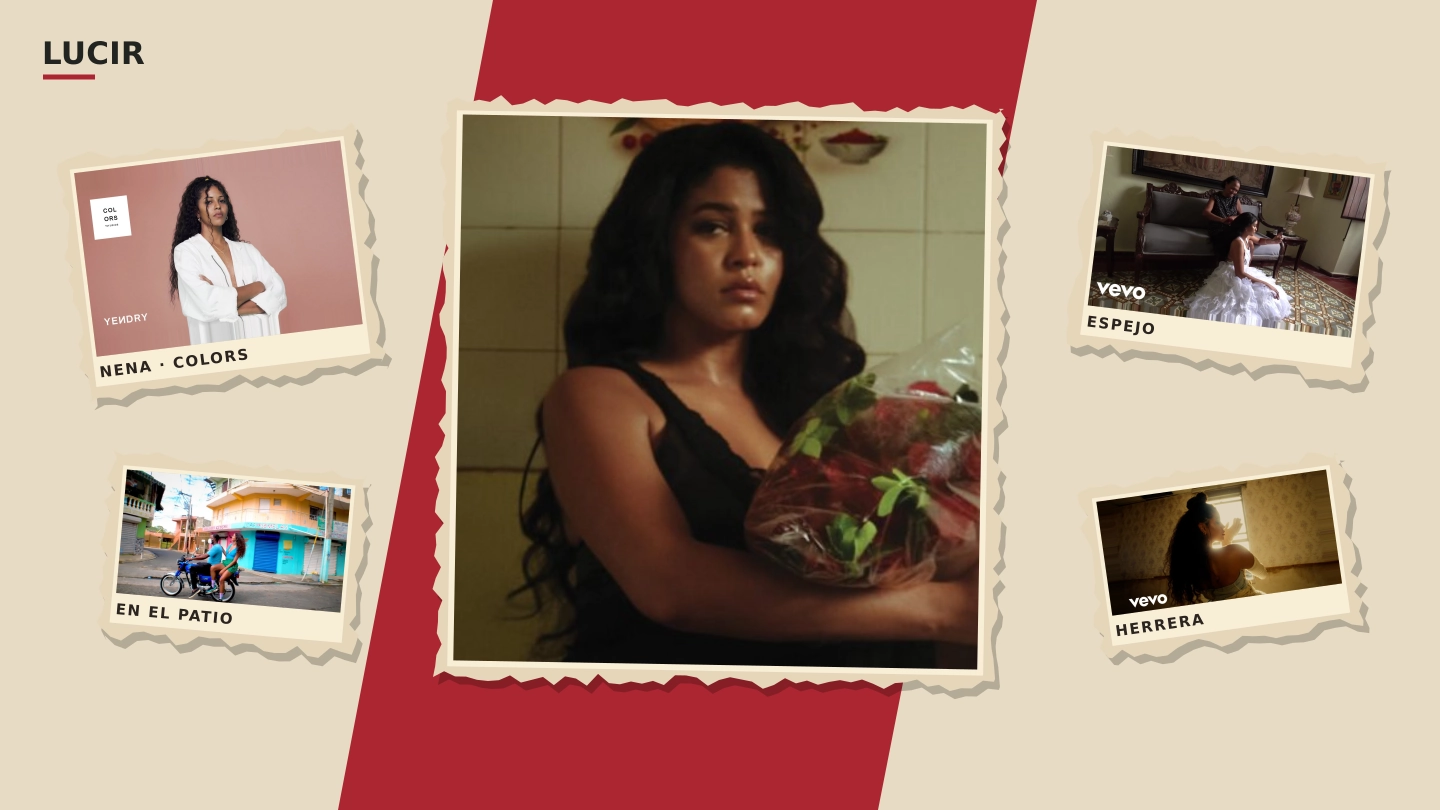
People who’d seen Yendry compete in season six of X Factor Italy in 2012 recognized her at a pizzeria and asked what she was doing working there. Working, I imagine. What I’d like to know is what they thought she was doing on television. She was trying to make a living there, too.
In her interview with Rolling Stone Italia, she remembered singing for fifty euros and having to negotiate to get dinner thrown in. She eventually left school because she was working seven days a week.
I’d like us to remember that the next time we ask why somebody with that much talent took so long to make an album. Took so long according to whom? She made music while she was doing the work that let her afford to make it. And she was figuring out what she wanted to sing about while people who recognized her face were still asking what she was doing there.
What her family had to say
The first Yendry song I heard was “Nena.” It is a haunting, melodic, otherworldly song, and yet I knew the world it came from. Yendry was born in the Dominican Republic. Her mother went to Italy ahead of her, and for about a year her grandmother and other relatives took care of her. She joined her mother in Turin, Italy, at four. When she wrote it, she told Pitchfork, she sang from her mother’s point of view, sending a blessing to the child she’d had to leave behind. Some of us know that story from the child’s side. I was four when my mother left for New York and my grandmother took care of me. When it was my turn to come to the States, I had to leave my grandmother, too. I wonder how many of us ever get around to asking our parents what they thought we understood about the decisions they made for us. Yendry gave her mother a whole song to answer.
Her mother gave her room to make a decision of her own, too. As Yendry recalled on Life in Spanglish, she already thought of her stepfather Mario as her dad when her biological father sent her a Dell laptop and a webcam. She was fifteen. Her aunt set her up on MSN Messenger, Microsoft’s chat app at the time, so she could talk to her father, and Yendry eventually flew to New York to meet him. Her mother let her decide when she was ready and what to make of him when she got there.
It takes some restraint to let your child get to know somebody you have your own history with, and I want her mother to get some credit for that. Years later, Yendry had something to say about that relationship in “Espejo.”
I like what happened when she turned the camera on the women who raised her. While making En el patio, she interviewed her mother and grandmother, neither of whom was used to being on camera. She told METAL that she got to hear how proud they were of her, something they didn’t often say out loud. As the saying goes, nadie es profeta en su propia tierra. In my experience, a lot of us know what that feels like, and I suspect Yendry does, too. People who barely knew her had no trouble singing her praises. And I get it: to her family, she’s Yendry, their girl, now a young woman. To the world, she’s a force to be reckoned with. Yes, she contains a multitude of talent.
The words she was glad to hear came from two people she’d known her whole life, and it took making a film to get them on the record.
Some of us aren’t exactly hungry for validation, but a lot of us weren’t raised to be openly affectionate with our own, either. Hearing our people say they’re proud of us is cathartic. It nourishes the soul.
Who makes the music
Some of the first English she learned came from Rihanna and Beyoncé. In that Pitchfork interview, she described working out their lyrics with a dictionary and getting the printouts at a money-transfer shop. She was studying philosophy at the University of Turin when a classmate in bioethics invited her to sing in a studio with him and his brother, Alain Diamond. She went on to form Materianera with Diamond and Davide Cuccu. She told Vogue Italia that her fascination with black holes and planets helped shape the band’s early work. They came up with the name while looking at the stars from a balcony.
Her mother put her onto Yoskar Sarante and Frank Reyes, she told VEIN. In her mitú interview about Como agua, she looked back on discovering Björk and Radiohead on YouTube at eighteen. These days, Burial and Juan Luis Guerra both have a place in her rotation. She’d already told Pitchfork she wanted to give a Juan Luis Guerra cover an electronic treatment. Now that’s something I’d like to hear. There’s only so much you can learn from asking somebody where she’s from for the hundredth time.
I’ve said here and there that Dominicans are an invasive species. You can and will find us everywhere and anywhere but instead of wreaking havoc with the ecosystem, we enrich it. We sprinkle joy wherever we go, and by the time anybody notices, the fauna is family and everyone’s dancing. We come from a small island in the Caribbean, yet it still amazes me how much talent we send out into the world. Yendry is undeniably one of them. One of us.
On Como agua, there’s a fifty-three-second song called “Bachatero.” Read the credits: she produced and engineered the recording, Pedro Diaz Sanchez played guitar and sang, and Felix Peguero wrote the song. Yendry told WLRN that she recorded most of her own vocals. She also told mitú why she sought out Yasser Tejeda for “Herrera” and Edgar Molina for palo percussion. We’ll spend a whole paragraph saying an artist defies categorization and sometimes won’t spare a line for the people she called to get the sound right. I want us to know their names and to know that she knew whom to call.
I like how Yendry interacts with her fans online. She’s become a major artist, and for all that talent and attention, she still comes across as grounded, like she’s glad to hear from the people who listen to her.
Spend some time with her repertoire and listen to how she plays with her voice. She can take a line somewhere you didn’t expect and stop you in your tracks. Hear her sing in English with Damian Marley on “You”, then listen to her move between English and Spanish on “El Diablo”.
Her music is vivid enough with your eyes closed, and then you watch one of her videos and realize how much you were missing. She told Elle she co-directed the video for “La Puerta” with Alberto Chimenti Dezani. Listening to “La Puerta” is, as Enrique Iglesias would put it, una experiencia religiosa.
Yendry can do all that in the studio, and she can command a room, too. Give her a stage or sit her behind a desk and she’ll make the space hers. She sang “Nena” at her 2021 Tiny Desk Home Concert. When she sang it again at her 2026 Tiny Desk, she followed it with “Espejo.” Give her those two songs, in that order. A mother has something to say to the daughter she had to leave for a while, and the daughter, old enough to decide for herself, has something to say about the father she went to meet.
I suspect Yendry would be bigger in the Spanish-speaking market if she were a few shades lighter. We have no shortage of mediocre people willing to sell us Black music. Look at who keeps getting picked to be the face of it. It may even be more palpable in the Spanish-speaking market and that may is doing a lot of heavy lifting. In her study of reggaetón’s move into mainstream Latin pop, Petra Rivera-Rideau traces how the genre’s image changed and white Latino artists gained prominence. Yendry came into the scene with those majestic curls and the golden luster of her skin, the stuff of gods. I’ve written before about the privilege of white Hispanic, and I see it in who gets to sing Black music and be treated like a star for it.
I also suspect the industry isn’t giving her the marketing budget her art deserves. I’d bet that goes back to that pesky racism and anti-Dominican sentiment. Because ain’t no way a white Latina could do what Yendry does and not be plastered all over the world.
I think she has a better shot in the English-speaking market as a Black Latina, albeit a light-skinned one. I still don’t think she passes what amounts to a brown paper bag test in Latin America. Among many of our Latin-Gringos in the States, too. Nobody needs to take out an actual bag for you to see who keeps getting let in. In Pew’s survey of U.S. Latinos, 41 percent of darker-skinned respondents said another Latino had discriminated against them or treated them unfairly, compared with 25 percent of lighter-skinned respondents. And no, I’m not handing the English-speaking music business a medal, either.
I wish more Spanish speakers and more English speakers knew Yendry and her music. I wouldn’t stop at calling it highbrow urban, though. And it’s not like she’s making music for the purists only. I would, however, call her work transcendent.
I want people of all generations to hear it, because, trust, you will learn from it, find something of yourself in it, but more importantly, you’ll enjoy it.
I hope this piece is a membrane between her universe and yours, a puerta for you to enter and get to know the many worlds of Yendry.
The mesmerizing art she shares with us is the doorway.
Come in.
For more and reading
- Yendry on Life in Spanglish and her Pitchfork interview, in her own words on family, growing up in Italy and making music.
- Yendry in METAL, on interviewing her mother and grandmother for En el patio.
- Yendry in mitú, on the music she grew up with and the collaborators who helped shape Como agua.
- Yendry on WLRN, in conversation with Natu Tweh about recording her own vocals and how her life across countries shaped the album.
- The Ex-Canonization of My Grandmother Nigela Hernandez, César Vargas, on the women who raised him and what migration asked of his family.
- The Privilege of White Hispanic: Leaving Out the Rest, César Vargas, on whose experiences get to stand for all Latinos.
- César Vargas: How I Became Black, on growing up Dominican and learning how differently race is read in New York.
- Race, Latinidad, and Latin Pop, Petra Rivera-Rideau, on reggaetón’s move into the mainstream, and Pew Research Center’s survey on discrimination among U.S. Latinos.
- Como agua and Yendry’s Tiny Desk sets from 2021 and 2026.