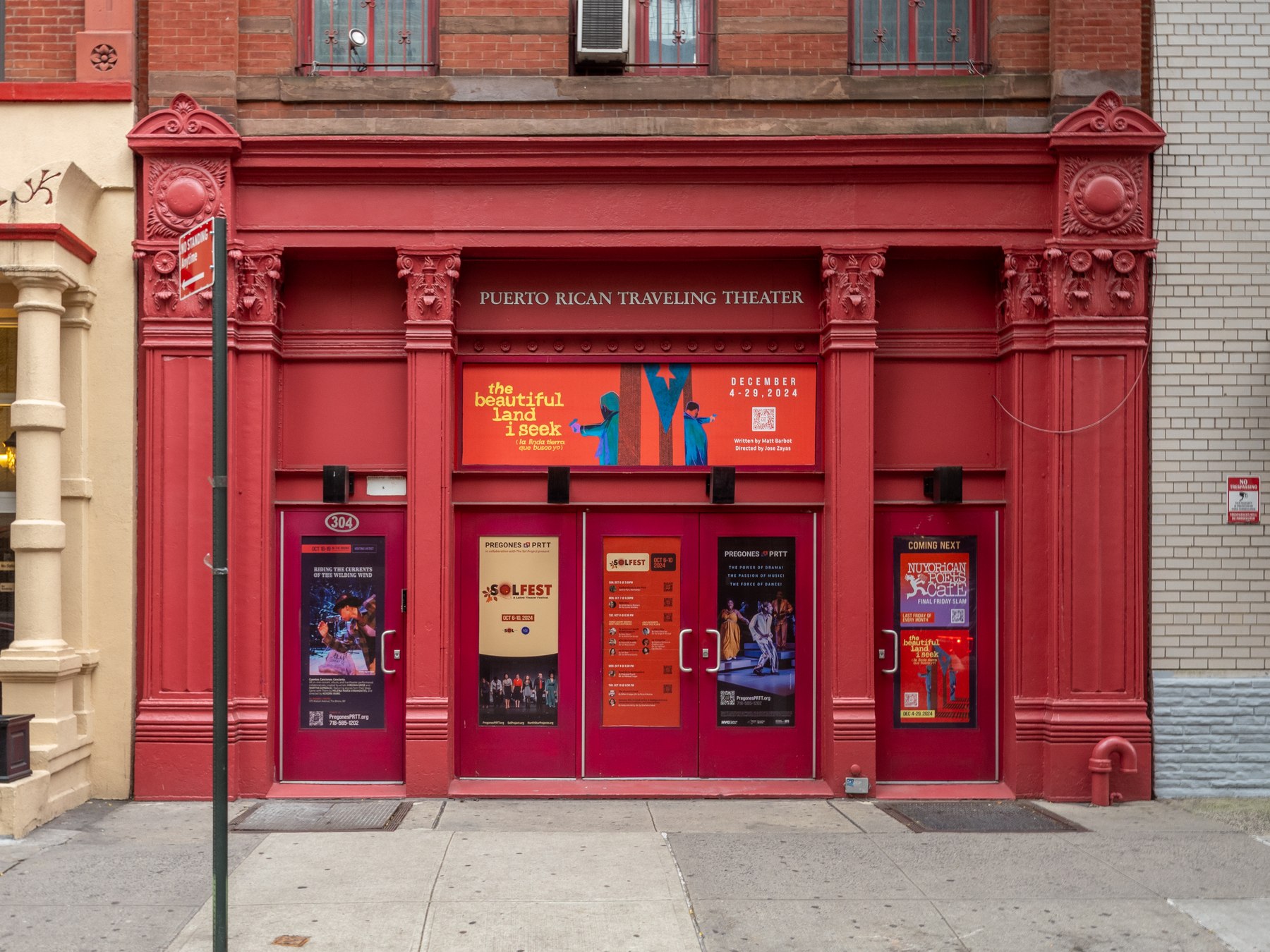
_-_47th_Street_Theatre_(54076032037).jpg)
Leave a Message After…THE BEEP begins with a useful formal proposition: a message can travel even when its speaker and listener do not occupy the same room. Pregones/PRTT has announced the original musical for October 15 through November 22 at the Puerto Rican Traveling Theater in Manhattan. Adapted and directed by Rosalba Rolón, with compositions and music direction by Desmar Guevara, the production draws from writing by Puerto Rican poets including Mariposa, Judith Ortiz Cofer and Julia de Burgos. The company’s production announcement places literary authorship at the center of the evening rather than treating poetry as decoration around a musical score.
The show’s title suggests a mechanism of delay, preservation and reply. A recorded message is intimate but incomplete; it retains a voice while withholding the immediate exchange that made the voice necessary. For a Puerto Rican and Nuyorican repertory, that condition can carry particular weight. Movement between the island and New York has created overlapping communities, vocabularies and memories without making them identical. The production’s collection format has room for connection without flattening those different locations into one story.
Rolón’s adaptation and Guevara’s music are distinct acts of authorship. Mariposa, Ortiz Cofer and de Burgos bring distinct literary histories to that frame. The poets provide language and images; the theater makers determine sequence, sound, bodies and duration. A stage version can make a poem communal, but it does not replace the poem’s original context. That distinction is especially valuable for a work built from multiple writers. It asks audiences to hear the musical as an arrangement of voices rather than as a single claim about Puerto Rican experience.
The producing company describes its work through Puerto Rican and Latinx artistic legacy, and this production makes that mission concrete through form. A poem can be read privately; onstage, it acquires a tempo, an audience and neighbors. A musical number can make the turn of a line audible in another way. The promise is not that every poem will resolve into harmony. The more compelling possibility is that a staged program can preserve friction among generations, genres and places while still creating a shared occasion.
A voice message also changes its listener. One person speaks to someone specific, but a recording can outlive its first purpose and reach strangers who bring different histories to it. Theater enlarges that shift: an audience hears private address together, while performers give words written at separate times a shared present. The production’s title offers a familiar prompt to speak after a signal, then leaves open who might eventually answer. Onstage, a poet’s distinct language, Guevara’s compositions and Rolón’s arrangement of the evening will have to make that open line compelling. The attraction is the possibility of hearing these voices beside one another without requiring them to say the same thing.