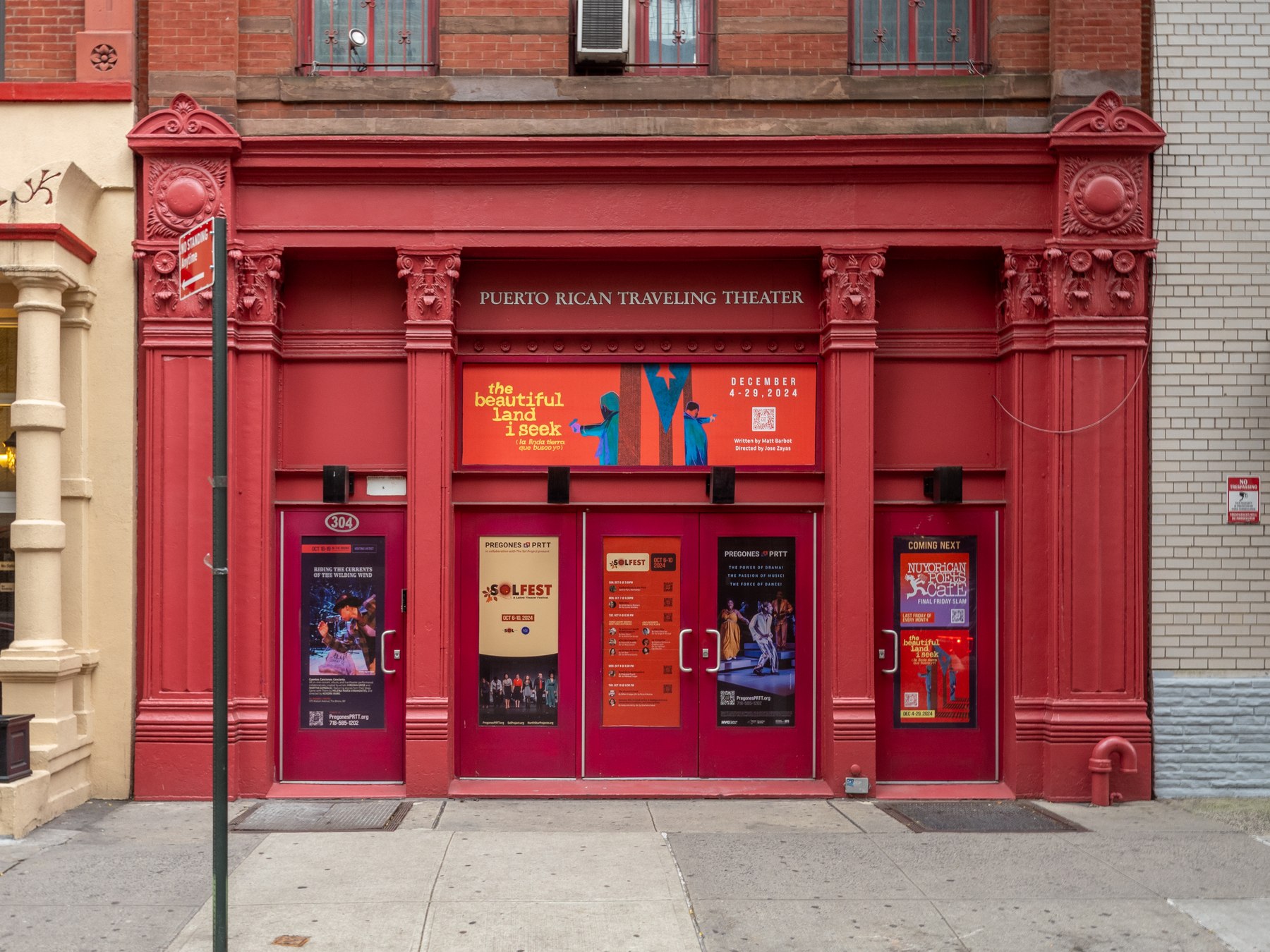
_-_47th_Street_Theatre_(54076032037).jpg)
Most plays ask an audience to sit still and consider another person’s problem. Doomscroll, a new forum-theater work announced by Pregones/PRTT, is built around a different proposition: the audience may have a role in testing responses. Puerto Rican playwright Alejandra Ramos Riera and director Jorge B. Merced are credited in the company’s announcement for the production, scheduled at Pregones Theater in the Bronx from December 1 through 12. The venue lists the event as free with RSVP.
The title names a familiar behavior without pretending that its causes are simple. Phone use can be a source of news, care, work and friendship as well as exhaustion. A play about scrolling gains force when it leaves room for those competing facts. The central question is not whether screens are good or bad. It is what happens to attention, conversation and health when a person’s hand keeps returning to a feed designed to continue.
Forum theater changes the usual relationship between issue and audience. Instead of receiving a finished moral, participants can enter a situation and propose another action. The experiment is dramatic as well as civic: a proposed intervention must contend with the other people onstage and with the conditions that made the conflict possible. That structure suits a habit that often feels private until people compare the work, worry or loneliness behind their screen time.
Pregones/PRTT’s public-health theater history gives the approach a local lineage. The company’s new work can be read as an extension of that practice without assuming that the new subject is identical to earlier campaigns. A phone is both a personal object and an infrastructure of alerts, family messages, school notices and labor. Forum theater can make that infrastructure visible because it treats a social problem as a scene people may interrupt, replay and debate.
The Bronx setting gives that experiment a neighborhood scale. The same device can carry a school notice, a shift schedule, a family call and an endless feed; any attempt to change phone use has to reckon with all four. A live forum can make those competing demands audible in one room. Ramos Riera’s script and Merced’s direction will determine how much agency the audience is given and what resistance its ideas encounter. The announced free RSVP matters because the invitation extends beyond a ticketed debate about technology. It asks neighbors to practice a conversation about attention together, in public, before anyone claims to have solved it.