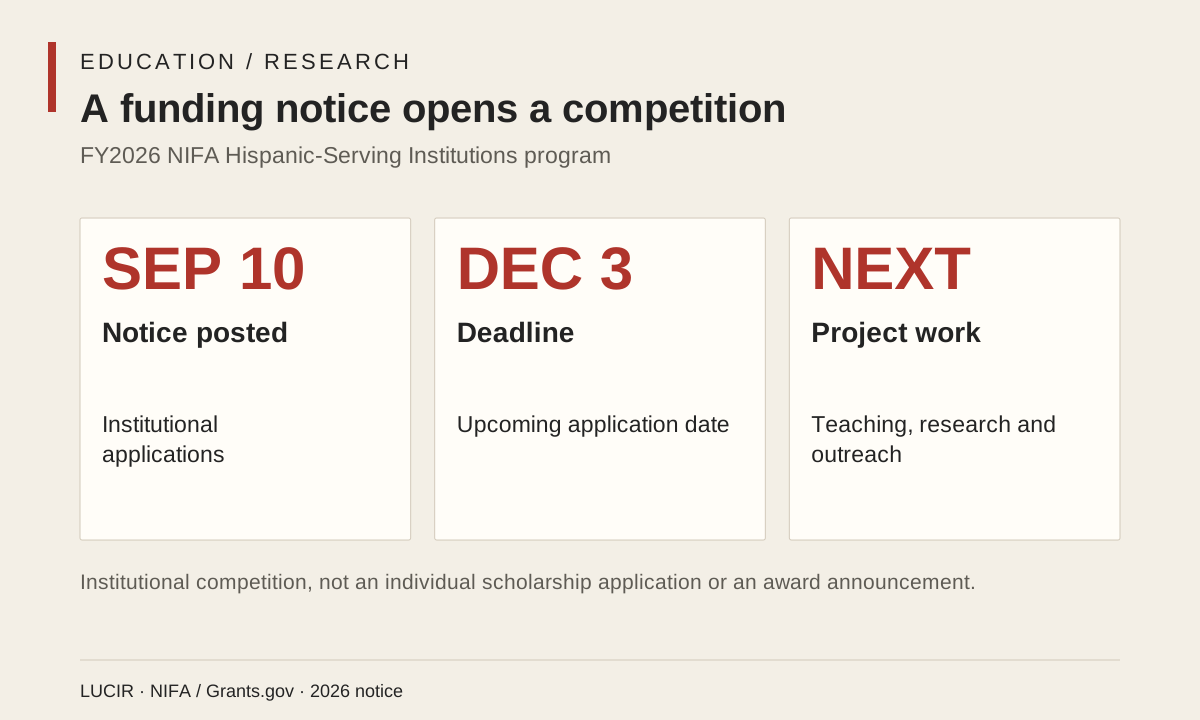
Agriculture is often pictured through a field or a harvest. Education adds another set of places: the classroom, the laboratory and the community organization where knowledge becomes usable. A federal Hispanic-Serving Institutions Education Grants Program notice, posted September 10, 2026, asks eligible colleges to connect teaching with applied research and community development. That connection deserves attention beyond the familiar image of Latino people solely as agricultural labor.
The notice lists December 3, 2026, as the application deadline. It is an institutional competition administered by the National Institute of Food and Agriculture, not an individual student scholarship application. A person reading the headline should not confuse an opportunity for a college to seek support with money already awarded to students. The funding notice describes proposed projects; it does not establish that any particular campus has won an award or delivered an outcome.
The program’s stated scope allows educational projects to incorporate student experience in applied research and community outreach. Its eligibility provisions focus on qualifying Hispanic-serving institutions, while the funded work is intended to benefit the institution’s broader population. Those two features belong together. A college can serve a substantial Latino student community while making its teaching and research useful across that campus and the communities connected to it.
What could that mean in practice? A proposed course might ask students to investigate a local agricultural problem and communicate findings to people affected by it. That is an illustrative possibility, not a description of an award announced in this notice. The meaningful question would be whether students help frame the problem, work with appropriate supervision and learn how evidence changes a decision. Participation should amount to more than appearing in a promotional photograph.
Community development also raises a question about whose knowledge enters the project. A partnership can begin by treating a community as a source of practical questions, rather than simply a destination for findings produced elsewhere. Students need ways to understand disagreement, uncertainty and the limits of what their methods can demonstrate. Research education becomes stronger when learning includes the responsibility of explaining those limits to an audience beyond the classroom.
The notice is worth following because it places colleges serving Latino students within a research and teaching conversation about agriculture. But the eventual measure should be concrete: what students learned to investigate, which relationships endured and what useful work reached a community. The opening of a funding competition is news. Whether a project widens the ability to produce knowledge will have to be established through its actual execution. That is a story about institutions and students, not an assumption that a grant announcement completes the work.