Adapted from
What are we saying when we call an artist one of ours?
There is pride in it, of course. Affection. The pleasure of seeing somebody from our people do beautiful work. But there is also a responsibility in that claim. We should know what we are proud of. We should be able to speak about the work with some of the care the person put into making it. Otherwise, we can spend a great deal of time celebrating representation while paying very little attention to the human being doing the representing.
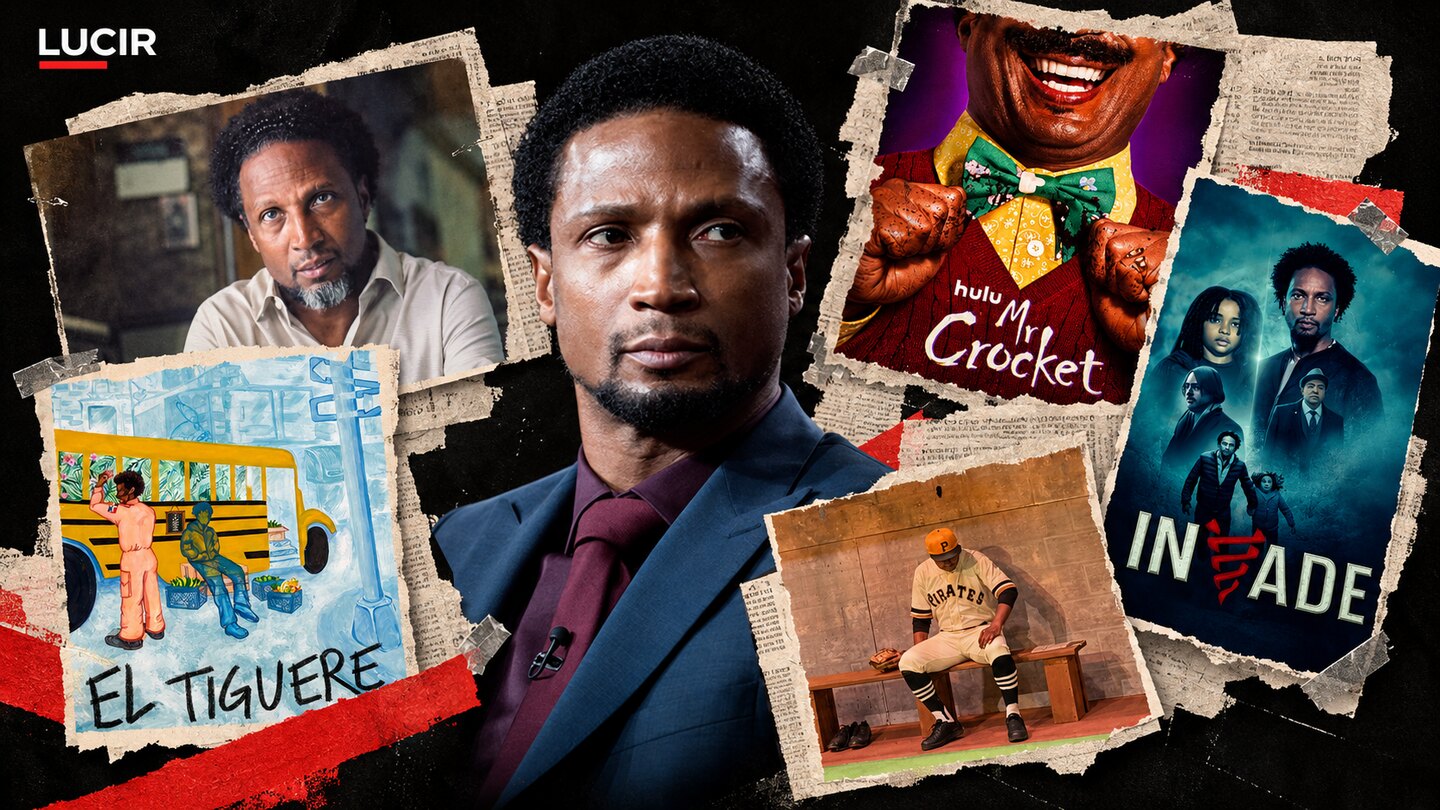
Elvis Nolasco is one of the best working actors of our time. He’s a veteran. He’s done the work and has an enviable track record. Lead or supporting, he brings his best. You can depend on him to deliver. Calling him a gem in plain sight is an invitation to look closely at a career that has already given us decades of reasons to admire him.
His work includes Darnell Martin’s I Like It Like That and Prison Song, Spike Lee’s Clockers, Oldboy and Da Sweet Blood of Jesus, and Michael Larnell’s Roxanne Roxanne. His professional résumé also includes Pedro Knight in Celia The Musical. There is a history here of working across different forms, with filmmakers returning to him for different demands. The familiar names of directors and productions should lead us toward the people who helped give those works their life. Nolasco is one of those people. His contribution belongs in the conversation about what those works accomplished.
American Crime gives us a particularly useful place to begin. In John Ridley’s anthology, Nolasco played Carter Nix, a man caught in addiction and accused of murder, and then returned as principal Chris Dixon. The first season’s story entangles Carter’s addiction with his relationship to Aubry Taylor. A role like that asks an actor to hold several difficult things together: dependency, love, desperation, the need to be believed. Any one of those things can take over a person’s story. The challenge is to keep a human being there amid all of them. Discussing a scene between Nolasco and Regina King on NPR’s Fresh Air, Ridley put their contribution plainly: “Elvis and Regina - they gave it life.” The writer could recognize what the actors had brought to the page.
And his work received individual recognition. Nolasco earned a 2015 Critics’ Choice Television nomination for Best Supporting Actor in a Movie or Limited Series for American Crime, along with a supporting-actor nomination in the Satellite Awards’ 2015 cycle. The International Press Academy also honored the American Crime cast with its television ensemble award. The individual nominations and the ensemble honor recognize both the actor’s own contribution and the work he made with others.
The move from Carter to Dixon shows another aspect of the craft. In a 2016 interview with The Philadelphia Inquirer, Nolasco described the change in how he walked and the difference between inhabiting Carter and an authority figure. An actor carries a character physically, including in habits we may register before we have heard a word. The work reaches into how a person enters a room and what he expects will happen to him there.
For Dixon, Nolasco went to actual schools. He spoke with the principal at his old high school in New York and shadowed principal Yolanda Gardea at Van Nuys High School in Los Angeles. He watched her work, asked questions, and learned something about the responsibilities he would have to inhabit. He described that preparation to the New Collective.
There is an intelligence in making yourself teachable. Especially when you already know your profession. A principal can become a convenient figure in a story: the person who disciplines, the person who decides, the institution given a face. Going into the school means allowing the person behind that authority to complicate your assumptions. It means accepting that somebody else knows something you need. The experience a veteran brings to a role can include knowing where his own experience ends.
Onstage, that capacity to imagine other lives takes another form. In the solo adaptation of The Brief Wondrous Life of Oscar Wao, adapted and directed by Elise Thoron, Nolasco carried an entire collection of characters. In the production’s program, Thoron said, “Elvis was the only person we found who felt like his life experience, talent, and passion could make this text shine.” Reviewing the 2018 Book-It Repertory Theatre presentation, BroadwayWorld’s Jay Irwin praised how he distinguished more than twenty of them through physical and vocal choices while keeping the audience drawn into the telling.
That is a demanding kind of clarity. One performer must make a crowded world legible without leaving the audience stranded between its people. It also gives us a richer way to think about representation: a Dominican actor holding many Dominican lives, with their differences intact. Even within a shared history, nobody has to be interchangeable. The craft makes room for that multiplicity.
Then consider the life Nolasco imagined for Mr. Crocket, the murderous children’s television host he plays in the 2024 horror film. He wrote the character a biography. In his account to UPI’s Fred Topel, Crocket became the son of West Indian immigrants, a child whose father’s expectations left little room for who he wanted to be. Some of that history remained part of Nolasco’s preparation, outside what the audience would learn explicitly.
A character like that makes the question of understanding uncomfortable. How much of another person’s humanity are we willing to consider once we know what they have done? An actor has to go into that discomfort. If he arrives with the verdict and nothing else, there is very little left to discover. Nolasco gave himself a childhood to work from, a history that could help him understand how this man came to imagine himself as a protector of children.
The audience is free to recoil. The actor still has to do the work of getting close. And that work registered with critics. Moviejawn’s Jenika McCrayer, while criticizing the screenplay, wrote, “The film should be viewed for Nolasco’s performance alone.”
In the same year, his screen work also included Frederick Douglass in Manhunt. That span deserves a moment: a figure of immense historical consequence and a fictional man whose idea of protecting children becomes monstrous. Each comes with a different burden. With Douglass, an actor has to contend with the public image that precedes the man. With Crocket, he has to find a man inside the horror.
Nolasco’s interest in Douglass also extended to his own creative work. In a 2023 interview with Life Entertainment, he discussed a separate short film he had made around Douglass’s Fourth of July oration. That is an artist choosing to spend time with a voice whose questions about freedom and national belonging remain difficult. His curiosity has somewhere to go even when somebody else has not handed him a part.
He also directed Time 2 Surrender, the short executive produced by Spike Lee. The film received an honorable mention for Best Short Narrative at the 2019 Pan African Film & Arts Festival. His collaboration with Lee takes another form here, with Nolasco directing. A director has to consider how one performer’s choices meet another’s, how those choices work within a scene, what the whole film asks of us. It gives an actor’s understanding of human behavior another place to work.
He is also a producer of Eunice Levis’s Ro & the Stardust, a bilingual fantasy about a teenager building a rocket to fulfill her dying grandmother’s wish to travel into space. Producing is a way of helping another filmmaker’s vision reach an audience. In this case, that vision gives a family’s love and grief the freedom of fantasy. Our people can carry their languages and their histories into imagined worlds, too. There is pleasure in seeing Nolasco participate in making that possible, alongside the work he gives us as an actor.
There is a connection here that interests me. A suspect, a principal, a historical figure, a monster: all can arrive in a story with our judgment already attached. Nolasco’s preparation goes looking for the life that those judgments leave out. It is a generous use of imagination, including when the person being imagined is capable of terrible things. The range lies partly in his willingness to keep asking who is there.
And when he brings his own cultural knowledge into a role, that same attention becomes a way of making the world on screen more complete.
As Nat Pettigrew in Godfather of Harlem, alongside Forest Whitaker’s Bumpy Johnson, Nolasco has also made room for the Caribbean within the character’s world. He told Diario Libre that he proposed details drawn from Nat’s Upper Manhattan surroundings. Spanish and cha-cha-chá became part of Nat in the third season. Nolasco, born in New York to Dominican parents and raised with summers in Villa Consuelo, had a history to draw from.
Think about what that kind of detail allows. A Black man speaking Spanish can inhabit the same life, the same neighborhood, the same body without an explanation that treats those things as incompatible. The Caribbean already belongs in the story of New York. An actor who knows that world can help a character belong to it more fully. There is knowledge in what he brings, and there is authorship in the choice to bring it.
His work in Godfather of Harlem brought recognition in the Dominican Republic, too. El Día’s list of the 2026 Soberano winners, attributed to Acroarte, names Nolasco as the winner in the category for an actor or actress distinguished abroad. That honor belongs alongside the American Crime nominations and the appreciation of his stage work. The recognition stretches across years and across the different places to which his career belongs.
That is part of what we should be celebrating when we celebrate Elvis. His capacity to give other people dimension. His contribution to the stories themselves, through performance, direction and producing. The years of practice behind choices an audience may experience in seconds.
One of ours should carry some reciprocity. If we take pride in an artist’s accomplishments, let us also take an interest in how he accomplished them. Let us give his work sustained attention, the pleasure of returning to it, the seriousness of talking about what he does. There is a particular joy in recognizing someone’s mastery while he is still working, still making choices, still giving us something to think about.
A Latino gem in plain sight. A master of his craft. Elvis Nolasco has earned his flowers.
The best of us. One of ours.