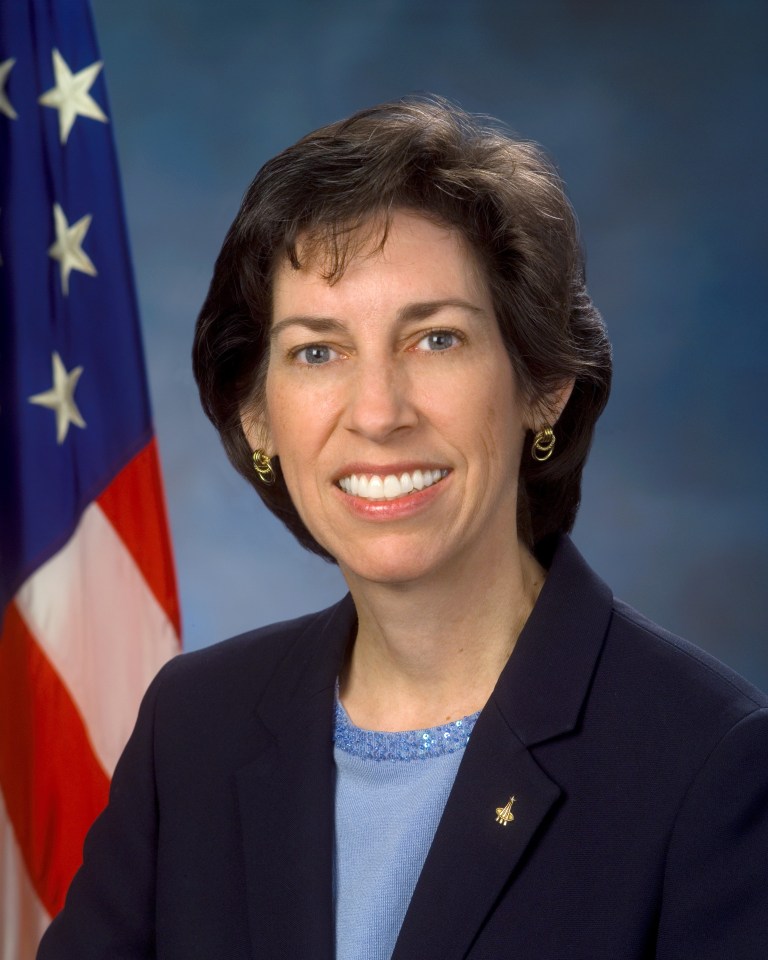
Ellen Ochoa became the first Hispanic woman in space aboard Discovery in 1993. That first is part of American history, but it is a poor job description. On four shuttle flights she worked with machinery that had to move satellites, station hardware and people safely through space. Later, as a NASA leader, she helped decide when a shuttle should stay on the ground. Her career is easier to understand through those responsibilities than through a single launch photograph.
Ochoa arrived with substantial technical experience. She earned a physics degree from San Diego State University and a doctorate in electrical engineering from Stanford. At Sandia National Laboratories and NASA’s Ames Research Center, she worked on optical systems; NASA credits her as a co-inventor on three patents covering optical inspection, object recognition and noise removal in images. When she was selected as an astronaut in 1990, she managed a branch of 35 researchers at Ames. The work was collaborative and exacting long before it was visible to the public.
In orbit, Ochoa operated the shuttle’s robotic arm on her first three flights. Her fourth mission, in 2002, put her at the controls of the station’s robotic arm. She maneuvered its S0 structural truss into place and helped position spacewalking astronauts. NASA also records her deploying and capturing satellites. These are controlled movements with little room for error, built on training that can be obscured by the romance of weightlessness. A spaceflight milestone records who got there; the mission record tells us what they were trusted to do.
Ochoa then moved through Flight Crew Operations leadership and became director of Johnson Space Center in 2013, the first Hispanic person and second woman to lead it. One episode from the years before that appointment shows what authority can look like on Earth. Former center director Michael Coats recalled that Ochoa objected when a shuttle’s detected hydrogen leak exceeded limits the team had agreed on. The launch was scrubbed. A countdown is designed to end in liftoff. Her decision treated the agreed safety limit as real even when the machinery, crews and audience were ready to proceed.
In a 2018 NASA oral history, Ochoa discussed why students benefit from seeing people of different backgrounds, hometowns and colleges at the agency. A single historic first can be inspiring; a visible range of paths makes an institution imaginable as a place to work. She did not describe that visibility as a substitute for competence. Her own route ran through research, operations and management, each with decisions that other people depended on.
She also praised The Martian for portraying NASA’s habit of identifying hazards, ranking risks and solving problems with a team. It is a revealing choice of story for someone whose career included both the robotic arm and a stopped launch. Ochoa’s legacy is not only that a barrier fell in 1993. It is the record of judgment she exercised after crossing it—and the example that record offers to people who may one day have to make a call as consequential as hers.