A face on a record cover tells us who is being presented to the public. It does not tell us everyone who made the record possible. That is where I want us to spend more time: with the people choosing musicians, shaping arrangements, building instrumentals and making decisions in the studio. Dominican contributions become much harder to overlook when the question changes from who is famous to who did the work.
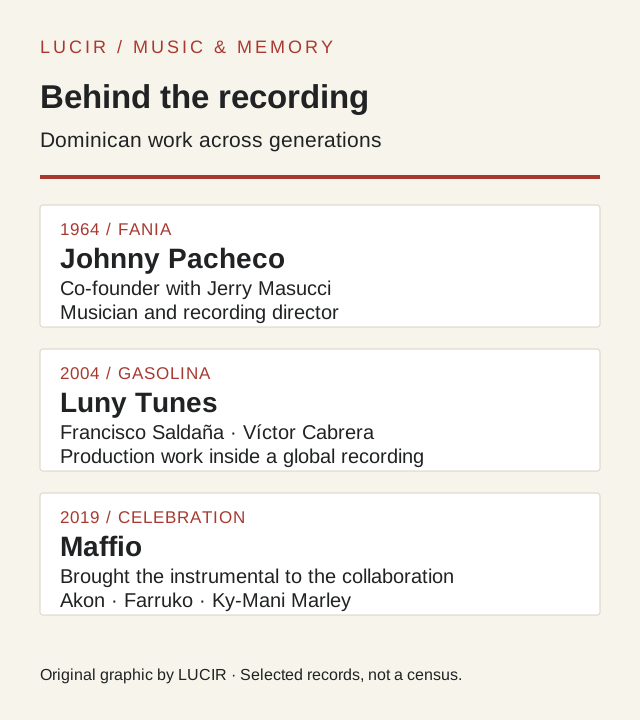
Start with Johnny Pacheco. Fania’s history dates his founding of the label with Jerry Masucci to 1964. Its account of Los Compadres also describes Pacheco’s work as recording director on early releases. He helped create an organization through which music could be recorded and circulated. As our closer look at his salsa work explains, those responsibilities belong beside the flute, the bandstand and the familiar name.
The production duo Luny Tunes offers another route into that history. BMI documents Francisco Saldaña and Víctor Cabrera’s Dominican origins and their move to Puerto Rico in 2001. Their production credit on “Gasolina” places them inside a defining reggaetón recording. A song can carry a star’s identity while also carrying decisions made by producers whose names take an extra click to find. Giving those decisions attention makes listening more interesting.
Maffio’s work brings that question into a different set of collaborations. Sony Music España’s biography identifies the Dominican producer Ariel Peralta, based in Miami, and describes his contribution to the sound of Nicky Jam’s Fénix. That label account supplies a concrete starting point for recognizing his work. It should lead us toward individual recordings and their credits, rather than the vague suggestion that a performer’s sound materialized alone.
For “Celebration,” there is a more specific account of the creative process. Sony’s October 2019 release describes Maffio bringing the instrumental to Akon and Farruko, who began writing and recorded that day; Ky-Mani Marley recorded later. Here the producer appears at the point when the collaboration takes shape. The instrumental is already an artistic proposition, something other artists can hear, answer and help develop.
These examples do not amount to a census of the industry. They do give us a useful way to report on it. Name the job. Identify the recording. Separate a label’s description from an independently documented credit. Then follow the next person whose work the credit reveals. Over time, that practice can change what readers notice when a song comes on.
I want young Dominican creators to encounter more than a narrow menu of visible roles. A producer can initiate a collaboration. A recording director can help shape a catalogue. The work behind the microphone deserves an audience of its own, with the same care we give the person standing in front of it.