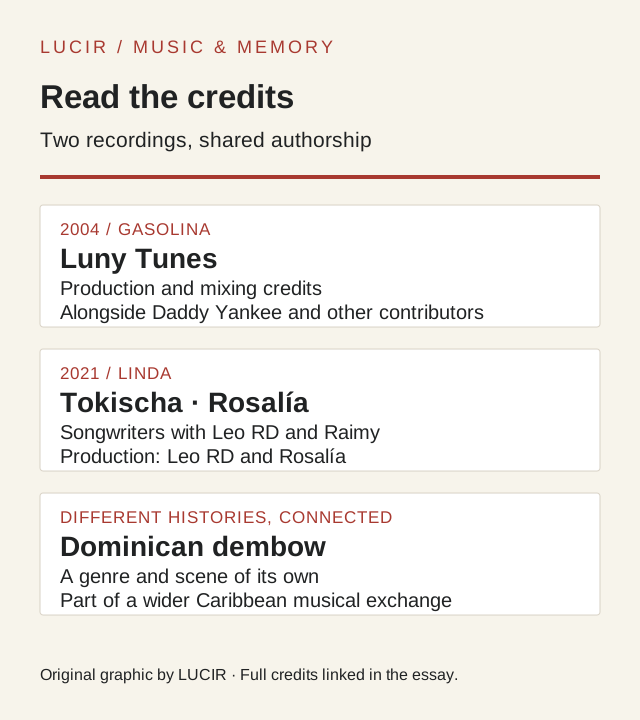
Before we argue about who belongs in reggaetón’s history, open the credits. On Daddy Yankee’s 2004 “Gasolina,” the recording metadata lists Luny Tunes as producers and mixing engineers. The other credits include writers Daddy Yankee and Eddie Ávila, background vocalist Glory, and additional engineers. Dominican participation is right there in the work. It does not need to be invented, and it should not need to be rescued from a footnote.
BMI’s account of the duo identifies Francisco “Luny” Saldaña and Víctor “Tunes” Cabrera as originally from the Dominican Republic. Their route passed through Massachusetts before they moved to Puerto Rico in 2001 and worked alongside DJ Nelson. That journey complicates the habit of assigning music a single national address. Puerto Rico was a place of creation and collaboration; Dominican migration was part of what arrived there.
There is a difference between recognizing that contribution and claiming every beginning. Berklee’s history of dembow follows the rhythm through Jamaican dancehall and distinguishes Dominican dembow as a faster, harder genre that developed from Puerto Rican reggaetón. The shared word can confuse the discussion: a riddim and a later Dominican scene are connected, but they are not interchangeable. Jamaica, Panama and Puerto Rico remain indispensable to the larger history.
We should be capable of holding those facts together. The 2009 collection Reggaeton, edited by Raquel Z. Rivera, Wayne Marshall and Deborah Pacini Hernández, approaches the music through movement across countries and communities. Pacini Hernández is among the scholars whose work makes that wider conversation possible. Reading this history as an exchange gives us more to investigate than a contest over which flag gets the entire stage.
Then listen to what happens when Dominican dembow travels under its own name. In Sony’s 2021 announcement for “Linda,” Tokischa, Rosalía, Leo RD and Raimy receive songwriting credit; Leo RD and Rosalía receive production credit. The accompanying video was filmed in the Dominican Republic. Tokischa’s presence is not just a location or an accent surrounding somebody else’s music. The credits document collaboration in the making of the song.
For me, representation has to reach this level of detail. Who built the track? Who wrote it? Whose local practice becomes an international sound, and who still gets named when it does? Our look at Dominican production work continues those questions across decades. We can celebrate Puerto Rican reggaetón, respect its Black Caribbean foundations and insist on Dominican visibility at the same time. A fuller history leaves more people audible.