Telling us to disconnect is easy when you can afford what we stand to lose.
From WhatsApp? From Instagram? From Facebook? From TikTok? From YouTube? Many of our people use YouTube to learn, find information and communicate. And can we afford to miss out on new technology and AI? Technology can help us learn, create and care for one another. It can also be used to exploit, exclude and control. What matters is how we use it, who controls it and who bears the consequences. I refuse to pretend otherwise, and I refuse to let either side of this conversation pretend that our lives come with the same resources.
Some people can afford to disconnect. Others need to answer the school, find work, check on family, translate a document, keep a business moving and somehow get through the day. Before you tell us to put the phone down, tell us who will pick up everything it is holding.
Can any of us afford to disconnect? This question cuts across racial and ethnic lines, through class, disability, caregiving and the demands of making a living. And why shouldn’t a Latino’s experience be a starting point for understanding the human condition? Why are some people allowed to speak for the world while the rest of us are expected to speak only for our demographic? Our lives are not a niche. We work, care, create, struggle and imagine what comes next. We can speak about all of it.
That freedom to speak across subjects matters to me because my own interests have never stayed in one lane. As a child, I wanted to be a scientist. As a young man, music came first. I also dreamed of being a basketball player, but height, space and safety? Come on. Mechanical engineering was the safe bet, and I intended to study it, but I loved it, too.
I had an eclectic hunger for knowledge, with a special interest in psychology, sociology, anthropology, Spanish and women’s studies, among other subjects. And culture was not something I studied from a distance. Hip-hop, R&B, bachata, our music and the world around it: I was deeply entrenched in that world. I wanted to understand how people behaved, what made them tick, how they survived and how they thrived. Not just the systems, but the people living within them. Perhaps all of that, along with my condition, my fears and that restless need to succeed rather than become another negative statistic, helped make me who I am today.
Technology and the internet gave that curiosity somewhere to go. When I went to college, the first thing I did with my financial-aid money was buy a computer. AOL, dial-up through the phone line, those discs. A whole world opened up. In Dominican chatrooms and other AOL chatrooms, I connected with people across the country and around the world. It was not just access to information. It was access to one another. Then came social networks like MySpace. I was there, too, acting a fool. But that same freedom to explore was about more than socializing. I could follow my own questions and do my own research without being confined to a strict curriculum. For someone who had grown up in the ghetto without that access, it was enormous.
I no longer had to fear for my life walking to a library just to reach information. Nor did my learning have to stop at what a teacher or professor chose to teach, filtered through their own biases and the curriculum and institutional rules they had to follow. Academia could open doors and still have suffocating rules about where you were allowed to go. The internet let me keep looking beyond them.
I love STEM, the humanities, the arts and markets. Today, my work connects writing, new media, technology, markets, sociopolitical analysis, culture, film and communications, among other fields. Some would call that approach transdisciplinary: moving between fields, between the details, the systems and the people within them, and bringing what I learn in one space into another. I apply that approach throughout my life and work, especially in my advocacy. This is not just theory to me. I live what I talk about. Being recognized in one field should not become a box that keeps you out of another.
Technology runs through those interests, so I come to this conversation as a tech head, not a spectator. I am excited by what these tools can help us learn, create and build together, and by the possibilities they can open to people who have been kept out. But that excitement exists alongside the danger. Techno-fascism has arrived with so much force, so much power and so little ethical restraint. I want us to have access to the possibilities without surrendering to the people trying to control them.
We gotta roll with the times or stay behind. But keeping up does not mean keeping quiet about the harm. I use technology. I question it. Those are not mutually exclusive positions. Neither are wanting our people to have access and demanding that the companies selling that access be held accountable. I do not owe a corporation my devotion because its tools are useful. And I do not owe its critics a performance of deprivation to prove I understand the harm. For us, being disconnected can be dangerous, even life-threatening, when it means losing access to urgent information, support or a way to ask for help. I am not willing to put our safety on the line to prove a point.
What we stand to lose
I live online. I am a denizen of the digital world. I owe my career to technology, the internet, social media and my own community. I have found amazing friends, some of my best friends, along with work and connections I cherish. Even my rise to fame as a writer is tied to that world. That has been a blessing.
Those connections do wonders for this curmudgeon, this hermit who loves his solitude but still needs human connection. The digital world lets me have that connection and step away when I am overwhelmed. Sometimes I want to take a break, too. But I am deeply entrenched in it: for family, for friends, for my community, for work. I am not going to pretend those relationships and opportunities mean nothing just because I also need room to breathe. Wanting a break and being able to afford one are not the same thing.
I prefer to be low-key, to work behind the scenes. My family’s safety and well-being come first. Do I like being credited and profiled? Of course. Who doesn’t? But I want that attention to be measured, not an invitation to unwanted scrutiny or callousness toward my family.
I have had a taste of what visibility can bring. When my writing reached millions of people, I received death threats. People also kept reaching out, and I loved connecting with them. But others wasted my time or wanted to use me as their mule, not just for my ideas but for the execution, too, with no recompense for me. The fear was real, and so were my reasons for being cautious. That is part of why I have not finished my book. It was not laziness. And I have my own issues with that label and the ableist assumptions behind it. Trust that I move with purpose.
I understand that how I act, write and express myself, in any form and through any medium, has a real, material effect on people’s lives, not just my own. The same is true of other people’s behavior: their choices affect lives beyond their own. There is a difference between accepting the discomfort that comes with putting my work into the world and allowing that exposure to jeopardize my family’s safety and well-being or my own health. I want to stay connected and share our lives without making them available for consumption in ways that harm my family, me or the communities we are part of.
Even in so-called safe spaces, in “liberal” spaces, people would come up to me and think they could just lay it on me. Why had I criticized this person? Why was I holding that person accountable? I was not always sure whether they did not understand my position or thought they could intimidate me into backing down. It felt like I was being told who was above criticism, who I was supposed to answer to. Well, I do not operate like that. I could not know whether someone had sent them or they had volunteered themselves. Either way, the well-being of my people comes before any party, any sponsor, any institution or any person harming us.
This is not separate from the question of technology or connection. The physical world and the digital world meet in our relationships, our work and the ways we treat one another. Social media can connect us without freeing us from the habits and hierarchies we bring with us. Spaces created for us, and even those created by us and for us, still have pitfalls, real and imagined. I know they cannot all be perfect. Perhaps perfection is not something we will ever agree on. But we can recognize some shared truths: our feelings matter, our behavior has consequences, and connection should not require accepting cruelty, exploitation or threats as the price of belonging. I can do better. You can do better. We can all do better.
Who gets to be heard?
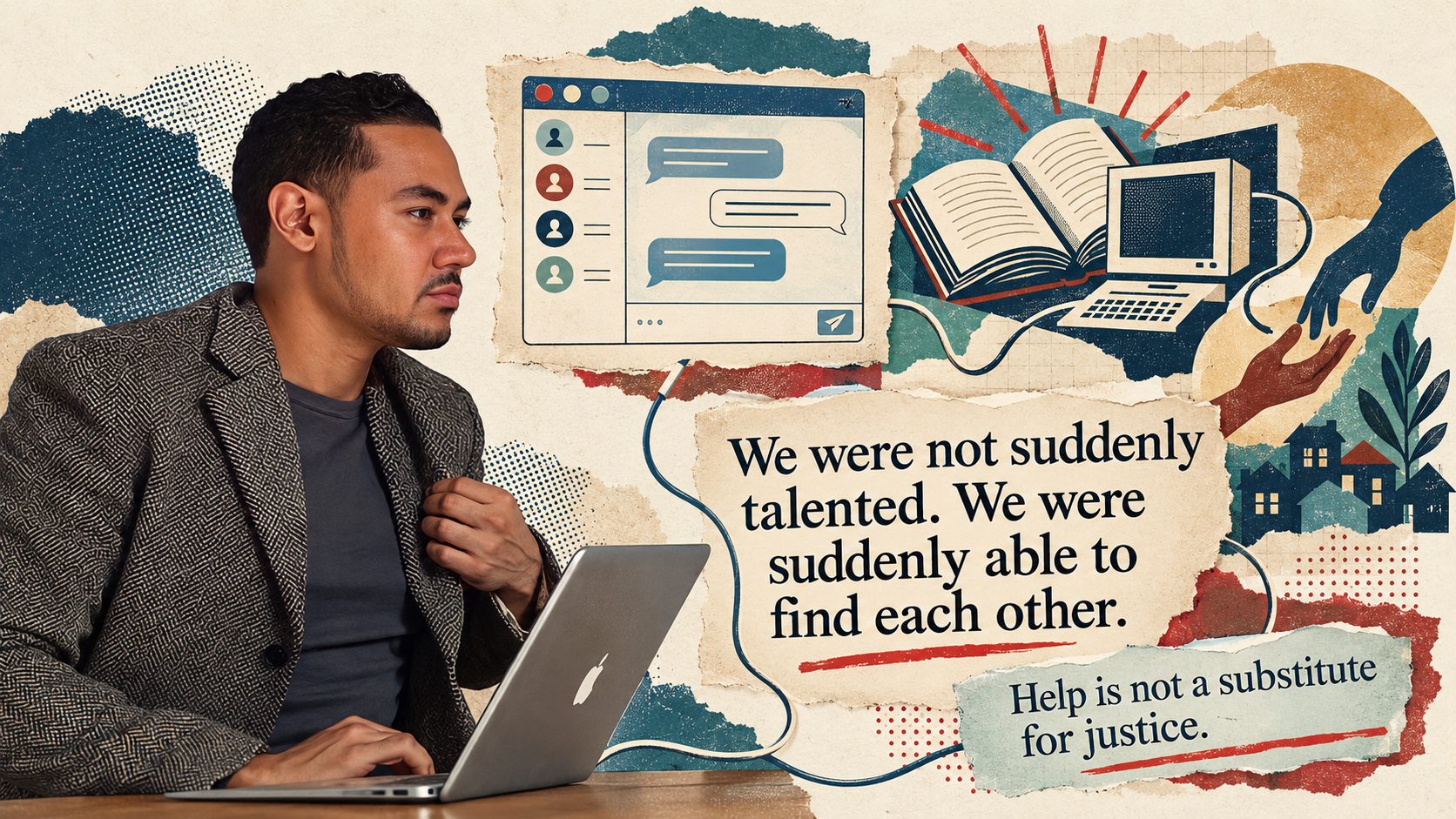
The digital world opened spaces that traditional media so often kept closed to us. It democratized our communication to an extent, not completely, not equally. But we did not have to wait for a newspaper, Hollywood, the government, a political party or academia to decide we were worth hearing. Many of us found audiences, work and one another without their invitation. We were not suddenly talented. We were suddenly able to find each other.
Some people get on social media to announce that social media is fake, that nothing there is real. Fair: people curate. People lie through their teeth, for reasons good, bad and everything in between. But curated does not mean inconsequential, and fake does not mean harmless. If this world is so trivial, why do governments, corporations and entities hiding behind other names put money and resources into influencing what happens there? Why the propaganda and covert influence operations? Why try to silence critics while amplifying other voices? Are we that oblivious? And sometimes I have to ask whether the dismissal is really about dishonesty, or about resenting who gets to be heard in a space the critics have not managed to dominate, where they do not receive the praise they are accustomed to elsewhere. Those other spaces have their own performances, dishonesty and real harm. Recognition there does not make them more authentic. Who gets to say what’s real and what’s a simulacrum of what matters?
We matter inside and outside these platforms, regardless of whether the powers that be grant us positions of power or recognition elsewhere. You have recognition outside social media? Good for you. Now respect the whole ecosystem. As Dewey puts it in Malcolm in the Middle, “The future is now, old man.”
I do not buy the idea that things were better for us simply because we saw less of what was happening. Being connected has given us more ways to document hate, abuse and exploitation, to hear from the people living through them and to recognize patterns beyond our own neighborhoods. Seeing that devastation on our screens can make the present feel worse than the past. But greater visibility is not, by itself, proof of greater harm. The monstrosity did not begin when we gained the means to record it. What went unseen was no less real or devastating to the people enduring it, and silence was never proof that it was rare. Technology and social media have helped open our eyes to how widespread it is. I do not want us to mistake knowing less for having lived in a better world.
And let’s not pretend the analog world was some sanctuary of dignified representation. Hollywood’s record of Latino erasure and stereotyping did not begin with an algorithm. Old media shut us out and sold the rest of the country and the world a caricature of us. It still does. They sold that caricature back to us, too. Many of us internalized those messages and acted, and still act, accordingly: voting against our own interests, repeating hate and lies, and treating people from our own communities as if we were better than them, above them. It is horrific to see us reproduce the contempt used against us. Returning to those gatekeepers is not my idea of healing.
A portrayal can change a perception, and that perception can change a life. It can open a door or help make a child look like a threat in a neighborhood they thought they could walk through without fearing for their life. That is how serious this is. Media, social media and the technology carrying those stories into our lives do not stay on the screen. They help shape how we see one another and what we find acceptable to do to one another. They can also challenge those perceptions, connect us to help and open possibilities we were denied. I have been talking about that good, too. But let’s be real and serious about the stakes instead of dismissing this whole world as silly and telling us we should just unplug from it all. That dismissal is dangerous.
And that matters when white supremacy would rather elevate one of us as the exception than reckon with the breadth of us. One approved genius, one acceptable voice, one person expected to stand in for millions. Online, we can encounter thousands of our own thinkers, artists, organizers and storytellers. One person getting through the door was never the same as the rest of us having access. I have written about having nowhere to turn but social media. Before telling us to abandon it, address the exclusions that pushed us there. Where, exactly, are you sending us?
Connection can become help
And those connections do more than make our work visible. Many of us use these spaces for mutual aid, to fundraise, to help someone survive and to bring attention to what traditional media overlooks. I have helped others raise money to keep a roof over their heads, put food on the table, support women and their children, pay for heart surgeries and everything in between.
Much of that I do not even announce. I keep it among friends, reach out privately and ask who can help. Through private messages, group chats and trusted digital networks, we can discreetly amplify an appeal, share information, raise funds and help people find safe spaces and resources. Being connected does not have to mean putting everything on public display. Other times, we need an audience to find the resources, pool our contributions and pull those funds together. A private message can get things moving; a public appeal can reach someone with the means to help. Both depend on being connected. Visibility is not always about being seen. Sometimes it is how we make sure someone else is not left unseen.
That is not the same as exploiting someone’s desperation for your own benefit. But even when I question how someone presents their help, I am not going to pretend my disapproval feeds the person who needs it. We can demand consent, dignity and accountability without demanding that someone go hungry until the help looks righteous enough for the rest of us. What good is all that concern behind the scenes if it never becomes something useful in someone’s life? Why deny them a hand while we debate the optics of extending one?
Of course organizing in person matters. But who said organizing online was any less useful or potent? And yes, we should demand more from our government. That does not mean abandoning someone while we wait for it to do its job. We can pull funds together today and fight the conditions that make those fundraisers necessary tomorrow. We can do both on the same damn day. Help is not a substitute for justice, and demanding justice is not an excuse to withhold help. We can juggle more than one responsibility. Attack the problem from every angle, bring help from every direction: online and in person, through friends, community organizations, public institutions and every other resource we can mobilize. Remove the digital connection and you can undermine all of this: how we find one another, coordinate help, pool resources and organize for change. Use the whole ecosystem. Connect the ecosystems. For all of us.
But mobilizing help through these platforms also exposes a vulnerability: we build the relationships and pull the funds together, while somebody else controls whether our appeals reach people. Our communities are real. Our control over the platforms is not. TikTok’s U.S. restructuring put its American recommendation system and moderation under a new joint venture. National security was the stated justification. Whatever the justification, ownership matters to those of us whose work and organizing depend on being heard. TikTok has previously acknowledged policies that restricted disabled creators’ reach. We can build something meaningful in these spaces and still have to fight the companies that decide how far it travels.
That control shapes not only who hears us, but what we are made to hear. The same digital world can overwhelm us with all the crap pushed into our feeds. I have already written about algorithms amplifying extreme views and polarizing us, and about disinformation damaging our relationships and communities. Needing these connections does not mean consenting to everything the platforms push through them.
And what are we doing with that connection? Who are we following, what are we learning, and what are we passing on? Why does an observation become brilliant in one person’s mouth and incendiary in another’s? Whose race, class, accent or credentials make us listen, and whose make us turn away? Being offline does not make somebody wiser or better than the rest of us. Being online all day does not mean we are nourishing ourselves, either.
We can be hungry for community and validation and still question what earns applause inside those spaces. A platform, a following, a familiar face: none of that excuses turning another marginalized group into the enemy. Even well-meaning people can help circulate the contempt they say they oppose. That is why I want us to question what gets rewarded, what gets repeated and whose interests it serves. Our grievances deserve attention. So do the people and institutions pouring fuel on them. If we spend all our energy fighting one another over the flames, when do we confront who keeps feeding the fire?
The exhaustion is real: research links problematic news consumption with poorer mental well-being. That is an association, not proof that every scroll makes us sick. It is still reason enough to take the exhaustion seriously instead of blaming people for needing the very spaces that exhaust them.
Who can afford to be unavailable?
Recognizing that exhaustion still leaves the question of who can afford relief. The issue is not whether everyone should spend more time staring at a screen. It is what happens to our responsibilities when we stop. Who has someone else handling the appointments, the paperwork, the scheduling, the messages? Who can miss a call without losing an opportunity? Who gets uninterrupted time because somebody else absorbs the interruptions?
These are the questions behind the conversations prompted by The Financial Diet’s post. Classism, racism, ableism, xenophobia, ageism and homophobia do not disappear because the advice comes wrapped in concern for our well-being. Wanting people to have more peace is not the problem. Acting as if everyone has the same means of securing it is.
Take Harry Styles telling Thom Yorke that his laptop had been dead for about six years. He also said he captures ideas on his phone, using GarageBand and voice notes. So no, this is not a story about a man who has escaped technology altogether.
And Christopher Nolan explained that he did not have a smartphone, while sometimes carrying a flip phone. He could be reached at work through the people around him. Matt Damon later described Emma Thomas texting actors before Nolan called them through a studio phone line.
That is the distinction: stepping away from a device is not the same as stepping outside the infrastructure, or the other people’s labor, that keeps you connected. Wealth can buy distance from the screen without cutting you off from opportunity. But can the workers who make that possible afford the same? Somebody has to stay reachable so somebody else can be unavailable. That is privilege, not a prescription the rest of us can simply follow.
For some of us, a phone is a way to reach family across borders, stay available to our children, find customers, organize help or get our work seen when the usual doors remain closed. That does not make every notification necessary or every platform benevolent. It means the dependency is more complicated than a failure of discipline.
And can we talk about the ableism in constantly berating people for using technology? Who needs that? Why not just get it yourself? Just get up. Just do it. Just, just, just. As if everybody has the same body, the same energy, the same capacity to get through the day.
What you dismiss as a convenience may be how someone else communicates, works, connects or subsists. You do not get to decide that somebody’s support is unnecessary because you can manage without it. Before demanding that we use less of what we depend on, ask what you are actually asking us to give up.
We do help each other. We do it when we have little money, little time and barely enough energy left for ourselves. But community is not an endless reserve of unpaid labor. A cousin is not a staffing agency. A friend is not a substitute for public infrastructure. Our generosity should not become another excuse to leave us without support.
And what about parents working day and night to survive, who cannot afford a babysitter or another extracurricular activity? Will Kyle and Becky come take over for a few? Will they volunteer their time, their money, their connections and resources? Or just their opinions?
Before handing a family another list of things to do, ask what time, money and help that list requires. Even the American Academy of Pediatrics calls for adequate childcare, extracurricular opportunities and community spaces alongside healthier digital environments. And a digital connection can help families find those programs, coordinate childcare, stay in touch with the school or ask their community for help. The phone we tell a parent to put down may be the very tool they are using to arrange support beyond the screen. Children deserve care and protection. Parents deserve support, not a lecture that pretends support is already there.
Being connected is not the same as being equipped
Making room for those responsibilities requires more than a connection. We need the knowledge and resources to navigate what comes through it. My concern about technology did not begin with the latest round of outrage. I have been writing about disinformation, damaged relationships and the need to share expertise and resources for years. My criticism has never required me to believe that leaving our communities less equipped is a victory.
My digital-literacy proposal called for tools, culturally relevant education and resources. Not shame. Not another lecture about what people should already know. Literacy takes instruction, equipment, time and people whose labor deserves to be paid.
Learning to question a system is not the same as giving up what we can gain from it. I went through hell to get my degree, but school sharpened how I understand the world and explain it so more of us can understand it, too. I can criticize what it cost me without denying what it gave me. The same goes for technology: confront the harm without leaving our people less equipped.
Solidarity must include the material security to make choices, not just advice about making better ones. That is why I have argued for reparations and a humane, anti-racist, anti-classist universal basic income. If we want people to have choices, we have to talk about the income, time and support that make choice possible. A lecture does not pay the rent, cover childcare or replace the work somebody loses.
And as I have written in my criticism of the positivity movement, poverty is not a character flaw. We cannot keep prescribing individual discipline for conditions people did not individually create. The answer to technological upheaval cannot be another demand that those with the least absorb the most.
Making disconnection a genuine choice also means building places and support we can turn to offline. Where do we practice being a community? In many American places, separated land uses and car-centered development make ordinary encounters harder. Some malls that served as gathering places have declined or become obsolete. A café may welcome us primarily as paying customers. Not every place is like this. But we need more third places, beyond home and work, where belonging does not arrive with a bill.
Then we tell people to heal. Heal, heal, heal. Alone, apparently. I have written that healing is a communal act because our well-being depends on what we build and how we treat one another. Boundaries are necessary. Turning indifference into a philosophy of healing is something else. If we want people to step away from their screens, we had better help build a world worth stepping into.
Access without surrender
Neither exclusion nor exploitation is an answer. If staying connected carries costs and disconnecting carries costs, our people need the power and resources to make real choices. What would that require? Affordable connections and equipment. Accessible tools. Education that speaks to our languages and our lives. Time to learn without risking the income that keeps the lights on. Real support for caregivers and independent creators. Worker protections. Platforms accountable to the communities that depend on them.
We also need critics who recognize that opting out can be expensive, and companies that cannot use our need for access as a shield against criticism. I have argued against centering an imagined middle-class norm because it makes poor and disabled people disappear from the discussion. A future designed around somebody else’s spare time, disposable income and support system is not automatically a future designed for us.
We need the whole ecosystem: people in different spaces, at different levels, pushing for policies that materially improve our communities’ lives. That includes Latino bankers, venture capitalists and patrons willing to put resources behind people who have been overlooked. Buy someone the laptop. Help pay for the equipment. Share your time, your knowledge, your connections. Fund the idea before somebody powerful gives you permission to recognize its brilliance.
That brilliance could belong to a Dominican kid in Brooklyn, a Mexican kid in Chicago, a Cuban kid in Georgia, or somebody in their forties, fifties or sixties who has been carrying an idea without the means to build it. Across our hues, nationalities and cultures, how much talent are we leaving stranded? Digital access can help that talent find knowledge, collaborators and people willing to put resources behind it. Support should give people room to create, not purchase the right to control them. Help privately or help publicly, with their dignity intact. The point is to get the resources where they are needed.
Being recognized for my work has not always meant being trusted with opportunities beyond it. My work in marketing and new media requires me to understand what works, what does not, and what might come next, including what is happening in the markets. I stay tuned in to technology and to what people are consuming, physically and digitally. I connect what happens at the macro level to what people experience at the micro level, watch products emerge and form my own judgments about what might take off. Staying connected helps me follow those changes. It is my duty to understand them for my work, my advocacy, my community and my family. I was writing about technology and warning about AI. I have also dissected Hollywood’s failures and why Latino networks and publications were tanking, giving concrete examples of what was not working and what could. And tank they did. CNN Latino and NBC Latino’s standalone website had already shut down when I wrote that piece, though NBC’s Latino coverage continued within NBCNews.com.
But being heard as a writer is not the same as being trusted to help decide which ideas receive investment. I believe I could bring something valuable to that work, too. Give me room to learn and contribute.
And this is not just about me. Look for brilliance in nontraditional places, beyond the familiar titles, institutions and circles. Being connected gives us more ways to find those people and encounter their work. We say talent can come from anywhere. But do we act on that belief? Do we put resources and opportunities behind it, or keep rewarding the same people? As Lauryn Hill asks, “How you gon’ win if you ain’t right within?”
For my work, for our communities, and for my family, I am constantly researching, looking for verified data and questioning what is behind it. Who wrote it? Who funded or sponsored it? What does it actually show, and what are our advocates and communities saying about it? I compare the research with people’s experiences and translate what I learn into something grounded in real life, something we can all understand and use. The internet does not do that thinking for me. But being connected is the doorway to the sources, people and conversations that help me do it.
Whatever brilliance I bring has limits, however. I keep checking my biases, working on how I express myself and learning how to navigate the world better, for myself and the people around me. Recognition should not be where curiosity goes to die.
Visibility is not ownership
That is another reason access has to mean more than being seen. People heard me online. They read me online. Being connected allowed my work and ideas to reach them. Yet resources that were unavailable for me sometimes appeared when it was time to pay somebody else to execute what I brought to the table. I have been hearing echoes of my rhetoric in panels and speeches for decades, and I love it. I want those ideas to travel. What I do not love is seeing someone use them solely for their own benefit, or turn them into tools against the bodies, minds, hearts and souls of the people we are trying to protect and uplift. But why should the person who helped develop them struggle while somebody else builds a career repeating them?
And this is about more than credit or compensation. I am the captain of my own ship. I want to do this work on my own terms, not on the terms the powers that be have laid out for me. I have seen how treacherous those terms can be for individuals and entire communities. Our geniuses, our talented people, get forged into weapons against us. I have seen it happen too often. I do not want my work turned against the people it exists to protect and uplift.
Connection can give us knowledge, community and opportunity while exposing us to surveillance, exploitation and demands on our lives. Disconnection can give us room to breathe while cutting us off from support. The question is not simply whether we connect. It is on whose terms, with how much control over our work and our lives, and at what cost. Access should help us build, own and sustain something, not simply make our ideas easier to extract. That requires consent, material support and relationships that give something back, with room for privacy, rest and a life beyond what somebody else can get out of us.
Make support reachable
And make those resources findable. An organization does not have to announce every person it helps, but I want our people to know where to go, what is available and how to reach it. Show us more than a photograph with a celebrity. Use those platforms to connect someone to an opportunity. There is a way to show the work without turning the people who need it into props for the next fundraiser.
I also want spaces where we can contribute as ourselves. Technology and social media have given me room to do that, and I am grateful for it. I do not know everyone’s motives, and I can be wrong. But I can still question the harm I see. Support should not depend on whether somebody is comfortable with every observation I make.
Organizations need procedures. But if getting help requires knowing the right person, using the right jargon or phrasing a request just so, who are those procedures serving? Putting a form online does not make access equitable if people still have to guess what will get them through the door. Explain the process. Make room for questions. Let people ask for help or offer their skills without humiliation, without having to flatter anyone or silence themselves. A connection should make it easier to participate, not give us another hierarchy to navigate.
And that support has to be sustainable. We cannot build the whole thing on somebody’s exhaustion and call it solidarity. None of us is immune to becoming the gatekeeper we once resented, myself included. I keep asking whether I am doing right by our community or simply making room for what feels familiar to me. We have to wrestle with our own biases, our egos and our assumptions about whose ideas will work. I want to help our people without sacrificing myself, my family or the very communities we claim to serve. We should be able to build something that sustains us, too.
Staying connected has helped me build those bridges beyond my own circles. I can connect with white, African American and Asian people across the country, with men, women and nonbinary people I might never have met if I were not plugged in. Those relationships can bring us into conversations our everyday surroundings might never offer. That includes African immigrants and conservatives willing to work toward shared material goals. Appreciate our differences. Judge the policies and the results. A party label or a familiar face cannot do that work for us. Who benefits? Who is still being left out? We need people with the wherewithal, the brilliance and the heart to ask those questions and act on the answers.
Can Latinos afford to disconnect? Collectively, I do not think we can afford to surrender the connections, knowledge and opportunities we have built here. But an individual’s need for rest cannot become a prescription that ignores what the rest of us depend on to get through the day.
Use the tools. Question the terms. Share what you learn. Demand more from the people who profit. We can want the possibilities without surrendering our judgment, our communities or our right to ask who pays for them.
That is part of why LUCIR exists: to tell our stories in full and make room for our people without waiting for the same gatekeepers to decide we matter. I am building ventures of my own, including this one, and I know how much an idea needs people willing to help it grow.
If you have an idea, want to collaborate or can help put resources behind this work, reach out to me through LUCIR. Fill out the form with your name, email, subject and a message telling me what you want to build, what you need or what you can bring.
If you need to unplug for your well-being, do it. We understand.
Let’s be there for each other, offline and online. With love, with respect, and the honesty to help each other grow.
Let’s connect.