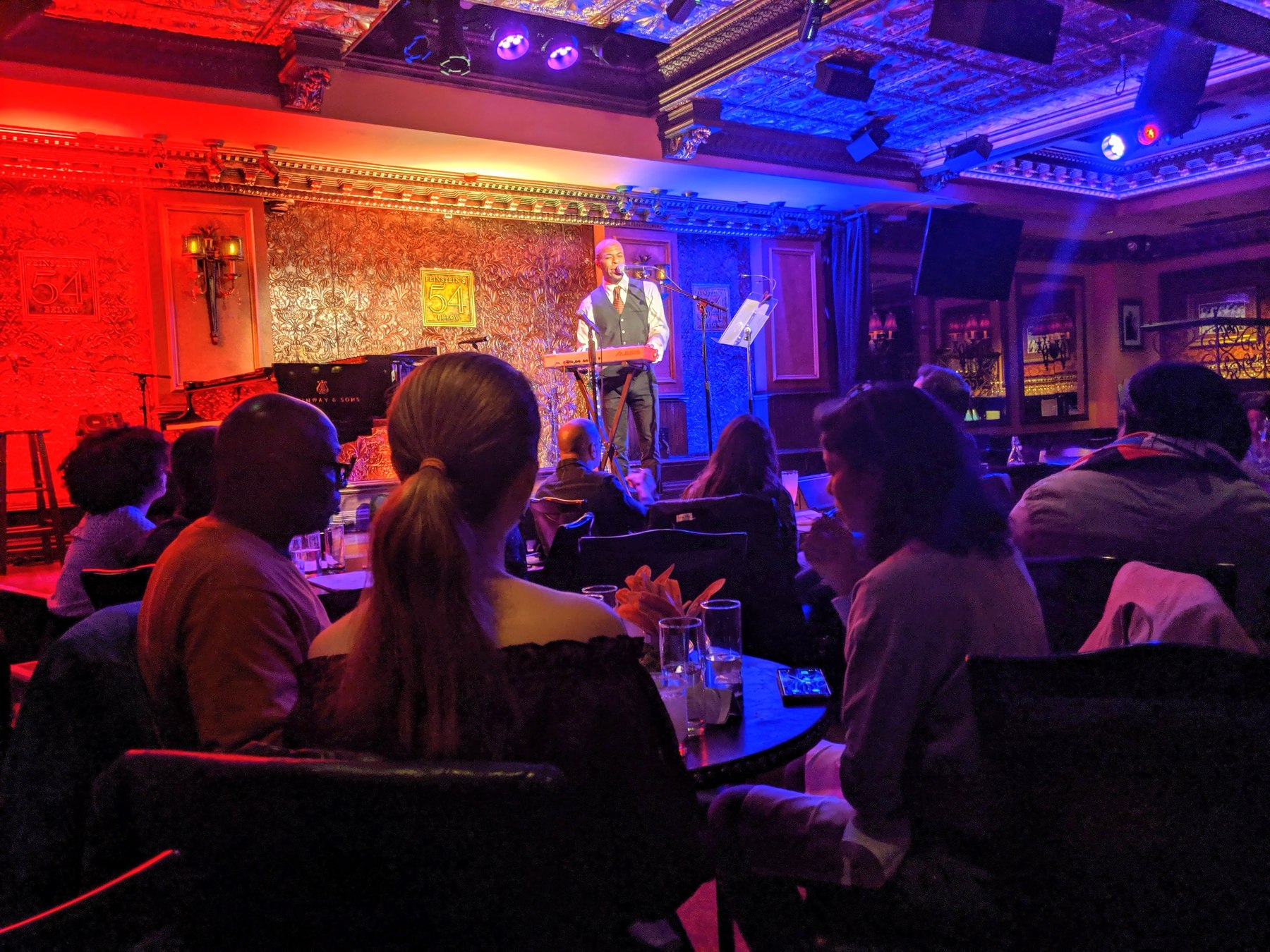

A title such as La Música de mi Casa asks whose home, and which music? The October 8 54 Below event, produced by Gabriela Torres, names Puerto Rican, Cuban, Mexican, Dominican and other Latino backgrounds. The venue describes an evening of Latino culture rather than a single genre. That breadth is useful if it remains a set of relationships among artists and traditions instead of a shortcut that treats distinct histories as interchangeable.
Home music often arrives before an audience knows how to classify it. A song might belong to a parent’s kitchen, a car ride, a celebration or a migration long before it receives a market category. A cabaret program can make those private associations public. It can also test them. Once songs from several diasporas appear in the same room, the sequence becomes an argument about what connects them and what should remain distinct.
The venue’s program names a wide musical range: merengue, reggaeton, salsa, Latin pop and Spanish rock. It also lists an ensemble including Lauren Brown, Salvador Diaz-DeBose, Valentina Ortiz, Micaela Ramos and Torres herself. Those details make the announced breadth more concrete than a generic heritage label. The challenge is how singers with different relationships to those styles move through one program without making any genre stand in for every background in the room.
54 Below’s Hispanic Heritage Month series frames these events as a platform for Latine and Hispanic artists. A platform is not neutral; its scale, location and ticketed setting shape who can enter. But a cabaret stage can create an occasion for artists to make affiliations audible before an audience that may not share every reference. The event’s multi-genre promise resists the expectation that Latino culture should arrive with one predictable rhythm.
The announced 9:30 p.m. event offers a shared room for material that may have begun in very different ones. A song learned from a grandparent, a recording played at a party and a piece chosen by a working singer do not arrive with identical histories. The staging can let performers name those histories in their own terms, making the transitions between numbers as significant as the numbers themselves. Torres’s production is therefore an invitation to listen for selection and sequence. A program that moves among several backgrounds has to decide when to draw a connection and when to let a sound retain its own place.
For listeners, the reward may be discovering a connection they did not expect, or hearing a familiar song in someone else’s interpretation. A shared stage can accommodate both recognition and disagreement about what home sounds like.