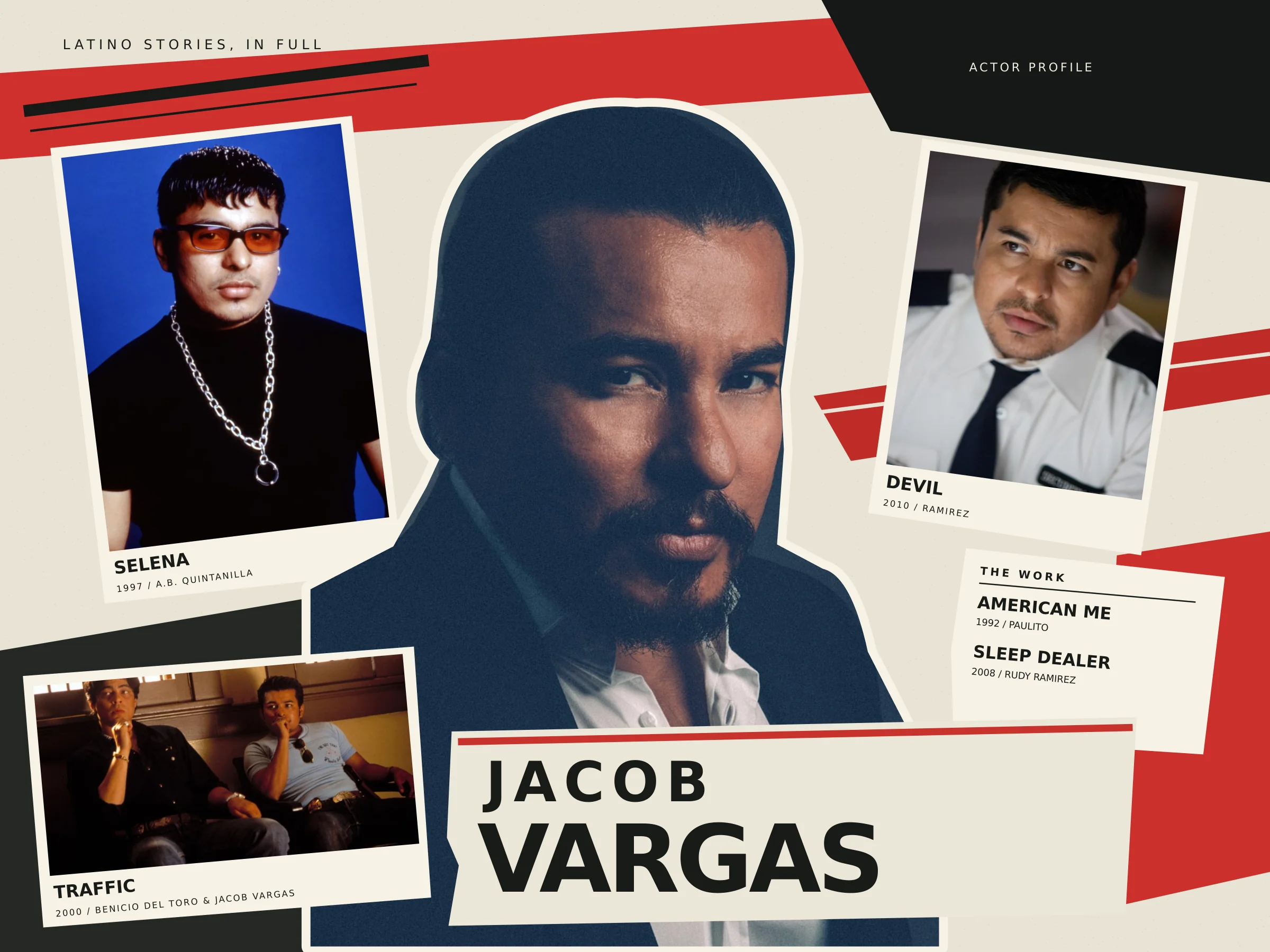
You know the face. Good. Now let’s talk about the actor.
Jacob Vargas was in the movies. The ones we quote, argue about, return to, and pass along. American Me. Mi Vida Loca. My Family. Selena. Traffic. Recognition comes easily. Giving the actor his name, and taking his work seriously enough to discuss it, requires a little more attention.
Vargas deserves that attention. Especially from us. I want us to get beyond treating a familiar Latino face as a pleasant surprise and start talking about the work that made him familiar in the first place.
Consider a small moment in Selena. Abraham Quintanilla is worrying about how the Mexican press will receive his daughter. Her Spanish, he warns, has to be perfect. Selena pushes back. Vargas, playing her brother A.B., laughs. The exchange belongs to the family as much as it belongs to the argument about identity.
That laugh matters. The scene carries an argument about who gets to belong and how exhausting it can be to satisfy everybody’s definition of Mexican enough, American enough, good enough. It also has siblings in it. A.B. gets to find the family situation funny. Vargas contributes to a scene about cultural pressure without making every second feel like a public-service announcement.
We should be able to appreciate that pleasure on its own terms. A Latino actor helping make a family convincing is doing artistic work. He does not need to rescue the entire community before we can call it valuable.
The family relationships across Vargas’s films also resist any tidy account of what a Latino man is supposed to represent. In Gregory Nava’s My Family, he plays young José, with Jennifer Lopez as young María. Two years later, in Nava’s Selena, they are siblings. The shift is a useful reminder of what actors do: the same familiar faces can create an entirely different relationship. Familiarity gives an audience a way in. It should never become an excuse to stop looking.
In American Me, the family connection turns poisonous. Vargas’s Paulito is the younger brother of Edward James Olmos’s Santana. As Santana begins questioning the violence that has organized his life, Paulito is being pulled toward it. By the film’s ending, the younger brother is recruiting other boys and participating in another act of violence. What the older man has learned does not arrive in time to keep Paulito from repeating the violence.
Calling that just another gangster role misses what the character is doing in the story. Paulito makes the cost generational. The film cannot contain its damage inside one man’s punishment or regret. There is somebody younger watching, learning, preparing to repeat it.
Born in Michoacán and raised in Pacoima, Vargas offers a different possibility in his own account of growing up. In a 2022 interview on More Than a Movie, he recalled breakdancing in Pacoima and how being known as a dancer could keep gangs from trying to recruit him. He described being discovered while picking up his sister from school, then getting work as a breakdancer on Diff’rent Strokes.
There is something worth holding onto there: an artistic identity existed before the acting career. A kid was already doing something with his body, his attention, his time. Hollywood did not invent that creativity when somebody finally offered him a job.
Vargas would later bring another younger-brother dynamic into Traffic. Benicio del Toro described his Javier’s relationship with Vargas’s Manolo that way in the film’s production notes, before drugs and money complicate the bond. The two actors belong to an ensemble that shared the 2001 Screen Actors Guild cast award. Vargas’s contribution sits inside that collective achievement. Ensemble acting still requires individual actors to make the relationships work.
Then there is Sleep Dealer, which deserves space in any discussion of his range. Alex Rivera’s science-fiction film imagines a sealed border and Mexican workers remotely operating machines in the United States. Vargas plays Rudy, a drone pilot whose attack kills the father of Memo, the young man at the center of the story. Later, Rudy searches for Memo through digitally recorded memories. The film’s premise and those sequences put him on both sides of a terrible distance: first able to inflict harm remotely, then compelled to encounter the people affected.
Here is a Latino character inside a future, implicated in its machinery and confronted with its consequences. We need room for that kind of moral difficulty. Representation becomes awfully small if the only characters we are allowed to value are exemplary people who never embarrass us.
Even a horror film gives Vargas room for specificity. In Devil, his security guard Ramirez watches frightening events unfold on elevator monitors. Asked about praying in Spanish during the film, Vargas connected it to his religious upbringing: “whenever I get freaked out or I pray I do it in Spanish.” He said the prayer brought him comfort while filming.
I love that detail. When fear gets into your body, the language you reach for can tell us something a biography cannot. Spanish is available to the character as something intimate, a response to fear, rather than an identifying label slapped onto the dialogue.
In 2024, American Me and My Family were both selected for the National Film Registry. Vargas’s work is part of films now formally recognized as American cultural heritage. We can acknowledge that without waiting for an institution to tell us what deserves our attention.
We can also ask more of the attention we give. Name the actor. Talk about the relationship he helps create, the humor he contributes, the contradiction his character carries. Let the conversation get past the relief of seeing somebody Latino on the screen and into the pleasure of considering what he does there.
We know the face. His name is Jacob Vargas. And there is a body of work behind it that deserves more than a passing nod.