Healthcare is often discussed as if fairness begins when a clinician walks into an exam room. By then, many people have already been sorted: by whether they can afford coverage, get time away from work, understand the forms, find a provider, or trust that they will be heard. A system can speak warmly about equal treatment while leaving those conditions untouched. That is not equity. It is a welcome sign hanging over a locked door.
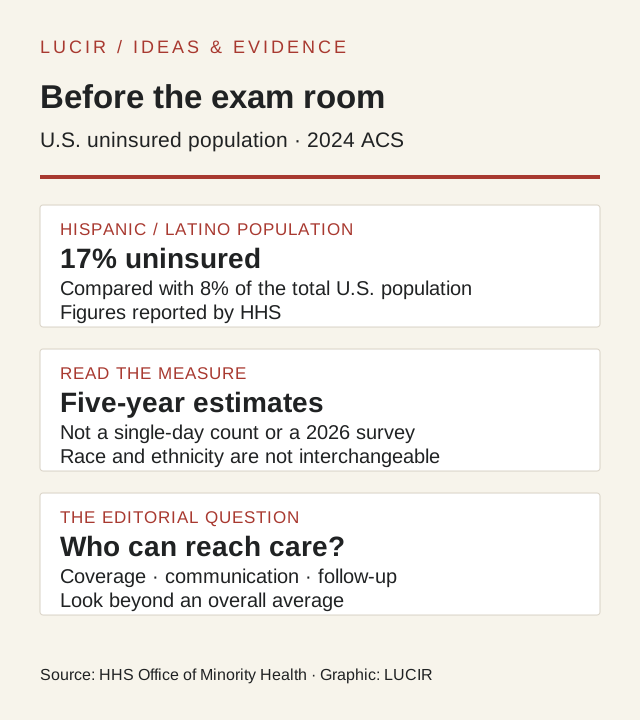
The federal evidence is plain enough to demand more than polite concern. The HHS Office of Minority Health profile, using 2024 American Community Survey five-year estimates, reports that 17% of Hispanic/Latino people in the United States were uninsured, compared with 8% of the total population. The same profile says that about 28% of Hispanic/Latino people age five and older reported speaking English less than very well. Its conclusion is practical: language barriers can make it harder to receive, understand, and follow medical instructions, and can contribute to inadequate services or avoiding care.
Those facts do not turn Latino people into a single patient population. We are different by race, birthplace, language, income, disability, geography, immigration history, and the care networks we can reach. But difference is precisely why a serious system must look beyond averages. If an institution only congratulates itself for an overall improvement, it can miss the people who still cannot get an appointment, communicate with a provider, afford medication, or return for follow-up.
The Agency for Healthcare Research and Quality’s 2023 National Healthcare Quality and Disparities Report exists because quality cannot be separated from access and fairness. Required by Congress, it tracks more than 250 measures across patient safety, person-centered care, care coordination, effective treatment, healthy living, and affordability, including disparities experienced by racial and socioeconomic groups. Measurement is not the finish line. It is the minimum proof that a health system is willing to see where it is failing people.
Fair treatment should mean more than asking patients to endure a maze with better manners. It means insurers, health systems, and public agencies must treat interpretation, accessible information, preventive care, and reliable follow-up as central to quality. It means reporting results by the communities affected, then explaining what changed when the numbers expose a gap. It means refusing the lazy fiction that unequal outcomes are only a matter of individual behavior.
I have argued that Latino public life deserves attention beyond immigration. Healthcare is one place where that broader attention must become public responsibility. People deserve care that reaches them before a crisis, information they can understand, and treatment that does not become less reliable because of language, income, or the neighborhood they call home. A country that can measure disparities has no excuse for treating them as invisible. The question is whether it will act with the urgency that its own evidence requires.