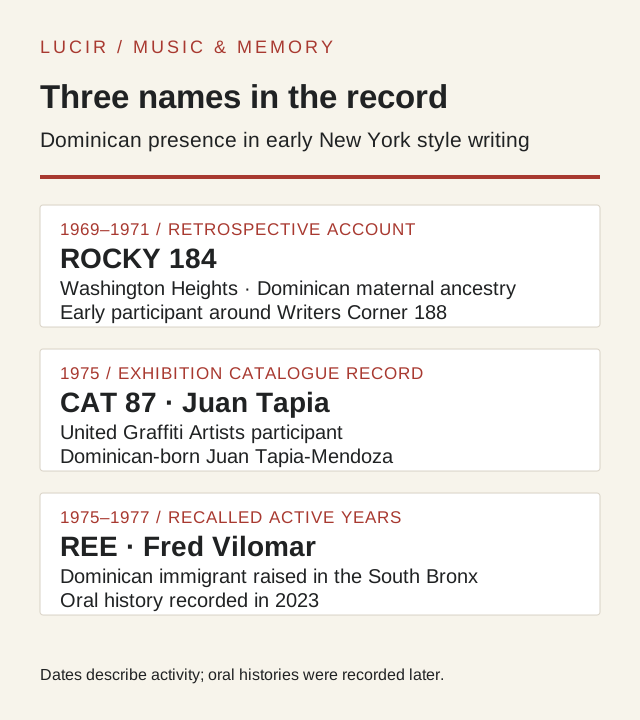
A name on a wall can be a claim to public space. For some Dominican New Yorkers and their descendants, that claim appeared in the city’s early style-writing scene before hip-hop had a settled name. The evidence does not make any one nationality the author of DJing, MCing, dance, and graffiti together. It does show Dominican participation in the visual language that later traveled with hip-hop.
Rocky 184’s 2022 oral history is unusually precise about both family and place. Her parents were born in New York; she says her mother’s family came from the Dominican Republic. She recalls growing up near Writers Corner 188 at Audubon Avenue in Washington Heights, among other young writers. An exhibition profile dates her writing with STITCH 1 there to 1969 and describes the corner’s emergence as a meeting place in 1971. Her Dominican connection is through her mother’s family, part of a life rooted in New York. Her account also restores a girl’s participation to a scene often narrated through boys’ names.
REE offers a different route into the same history. The Bronx Aerosol Arts Documentary Project identifies him as Fred Vilomar, a Dominican immigrant raised in the South Bronx. In his recorded interview he discusses arriving with his family in 1967, learning to write, and what he calls his strongest years, 1975 to 1977. The interview’s value lies in its specific testimony: a person, a neighborhood, and a period of practice. Reading his account beside Rocky’s shows how different generations entered the same expanding visual culture.
Juan Tapia-Mendoza’s name survives in another kind of trace. A dealer’s record of the 1975 United Graffiti Artists exhibition catalogue lists “CAT 87 Juan Tapia” among its participants. In a later public conversation, Tapia-Mendoza identifies himself as born in the Dominican Republic and describes his move to New York; the event’s introduction connects him to the CAT 87 name. The catalogue record points to a dated exhibition, while the conversation supplies the identity link. The move from a name in public space to a name in an exhibition deserves attention in its own right.
These records describe writing as social infrastructure as well as image-making. A corner let young artists meet and see one another’s names; a tag could travel beyond a block; an exhibition carried writers into a formal art setting. Those are distinct contributions, made by distinct people. Cornell’s Hip Hop Collection preserves flyers, photographs, recordings, artwork, and other materials because the culture’s history cannot be reconstructed from hit records alone. In that wider archive, Dominican participation in early New York visual culture deserves a documented place. Its significance grows clearer when the claim remains exact: foundational presence in style writing, within a citywide movement built by many communities.