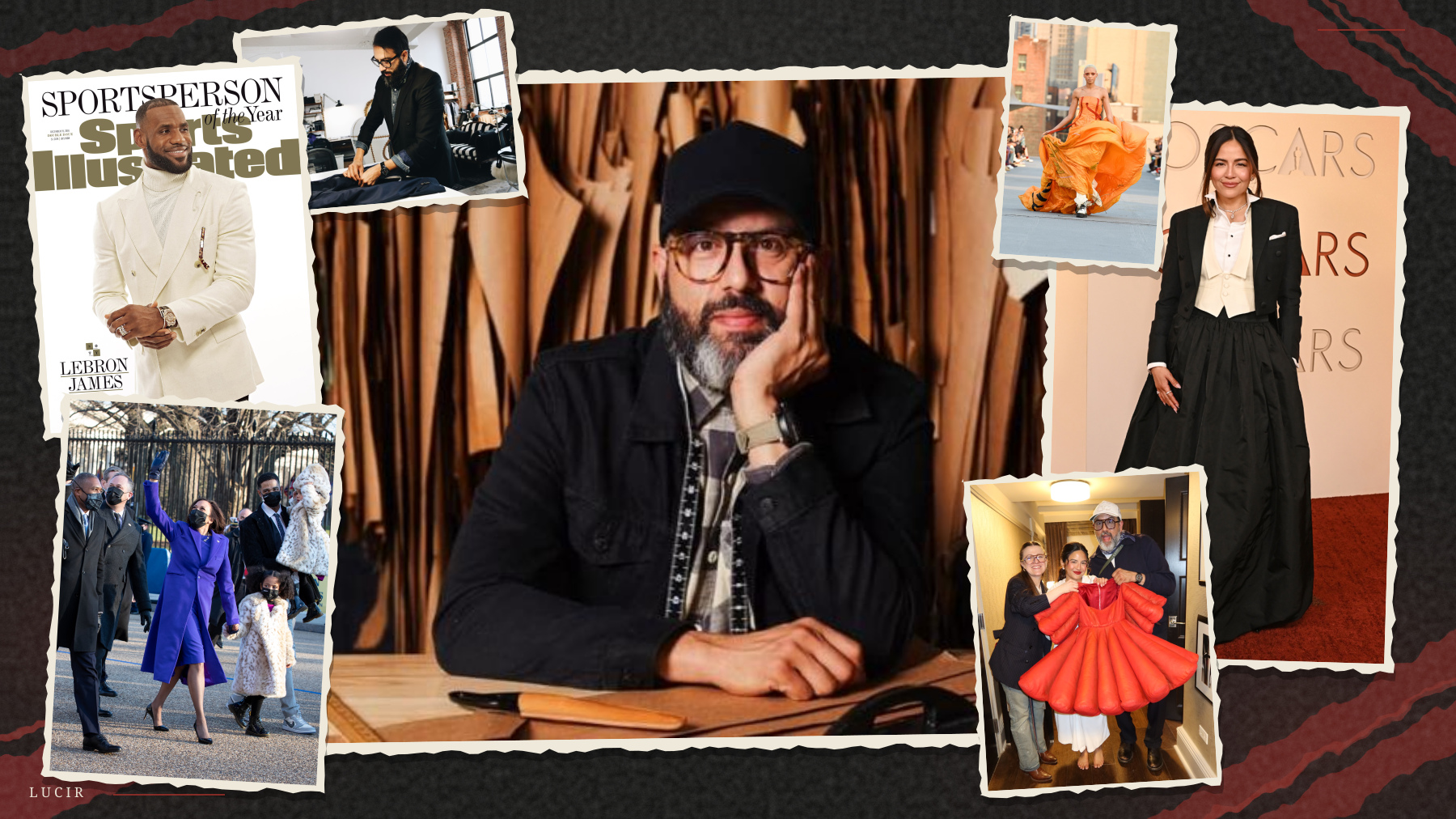
I call Arturo Castañeda Contreras a multidisciplinary genius. I mean the whole man.
The designer. The stylist. The storyteller. The mentor who sees something in another person and makes room for it to develop. We are friends. We chat, and I engage with his work. What I admire about him goes beyond what he can make with his own hands. It includes what he helps other people do with theirs.
I have been to his studio. I have spent time with him and his team. Arturo has this disarming warmth, this easy temperament that makes you feel at home. Even in foyers filled with hundreds of people, he has given me his undivided attention. He was not scanning the room for someone he thought was more deserving of his time. Who doesn’t love that? You can feel when someone is actually with you, and you can feel when they are waiting for a better invitation.
Some people spot you and turn their faces away, thinking you will not notice. And yes, some are genuinely busy or simply do not see you. But we are not stupid. We can smell the stench of their intention.
I have experienced that dismissal plenty. People who do not know me see me carrying a camera, or with my head down working, and decide I am some insignificant worker bee in the machine. As if there would be a fucking machine without those worker bees.
I do not carry my titles and accomplishments into spaces like a badge to make other people feel small. I even tell people not to introduce me as this genius, this brilliant writer, because some people cannot stand not being the apple of the introducer’s eye, the center of their attention.
À la The Talented Mr. Ripley. And the person making the introduction has no idea what awaits them at the other end of that relationship. Spoiler, man. You’re putting us all in danger, girl.
It’s like we are all back in middle school, but with grown-ass folks with graying hair. Unbelievable. We should not have to announce our résumés to be worth someone’s time.
And even some people who know me are like this. They think that because they are on leadership’s pedestal, they can break out their Hyde when leadership is not around. But around leadership? Dr. Jekyll. La mosquita muerta reigns supreme.
They have no qualms about it when we notice because they erroneously assume their time won’t come. And imagine treating such a public-facing writer with contempt? It’s only a matter of time, fam. Just wait.
That is why I notice when someone does not make me prove my importance before giving me their attention. Arturo never made me feel I had to earn his regard.
People often get my Dominican Kent: the stuttering dork, the accommodating, soft-spoken ninja. Then injustice enters the room and another of the multitudes I contain takes over. The switch to Dominican Superman gives people whiplash. And believe me, I have plenty to say and no intention of sparing anyone’s ego, no matter how much money they have or what position they hold, especially when someone else is being mistreated. Trust.
I have written so much about my own experiences here because our worlds and our experiences are intertwined. We are not alone. The good and the bad are not always isolated incidents, things that happened only to us. That is why I bring my experiences into this story: so we can recognize ourselves in them, and recognize in Arturo the kind of person we should all aspire to be.
Arturo gets the gentle me because he showed me the gentle side of him. He sees me and I see him. I thoroughly enjoyed those moments with him. And what I hear from others, especially those he has helped elevate, echoes the generosity I experienced: the pleasure of being present with someone who was present with me. Spending time with him was an honor, yes. It was enriching. And it was easy. His talent did not arrive in the room demanding that I get smaller. I could be around him and breathe.
And do not confuse his gentleness with passivity. He insists on inclusion, on people being treated right. Listen to how Arturo speaks about his team. He tells it without holding back.
He thanks, credits, and fights for the people the world wants hidden behind doors. Uncredited. Unappreciated. So-called essential workers when it is convenient to send them to the front lines, to put their bodies on the line. But when it is time for credit, pay, opportunity, a platform, admiration? Suddenly, not so essential. That deserves attention, too.
We have an extraordinary tolerance for talented people who treat everyone around them like shit. We have been sold this idea that creative geniuses must be cruel. As if cruelty were proof of their brilliance, and putting up with it the price of admission.
And somehow that cruelty knows exactly where to land. Not on their patrons. On their workers. On the very communities they claim to speak for while treating them as beneath them. Safe for some. Nasty to us. Traitors is what they are.
Maybe they do not know what they are doing. But then how brilliant are they, really, if they cannot recognize it? Or maybe they know exactly what they are doing. Maybe they have simply learned which words will keep them on the platform and which truths will get them removed. But that does not change the ugly truth: the beast they are now speaking in front of is the very one devouring their mothers, their parents, their communities.
I am also interested in another kind of creative life. One in which excellence does not require cruelty, and being generous with credit does not diminish the work. Arturo does not need to make people feel small for us to see how great he is.
The people behind the beautiful things
Mexican American and raised between South Texas and Mexico, Arturo learned from a mother who raised six children and worked as a seamstress. In a 2021 CFDA and ELLE conversation, he connected what she endured in factories to the workplace he wanted to create.
The way Arturo talks about his mother, Alicia Contreras Pacheco, is beautiful. He keeps bringing her into the story, and it moves me. He does not reduce her to what she endured or how much she worked. He keeps bringing us back to her genius. Her ingenuity. The creative mind that inspired his own. His mother introduced him to the craft, before they even called it fashion. Her ingenuity helped set him on the path that became his life’s work.
That is very different from turning our parents into symbols of sacrifice and stopping there. That is what fills me with righteous rage: when our parents’ suffering becomes the feel-good portion of a commencement speech or an awards ceremony.
I understand the love. I understand wanting to stand on that stage and tell everybody who helped you get there. Give them their flowers. Say their names.
But why are we expected to feel proud that our parents and ancestors had to grind down their minds, their bodies, their souls, their dreams, their lives so we could get an education? So we could have access to a platform? Things that should be a right, not a prize for surviving enough deprivation. A prize handed out by the very same people exploiting us.
I can be grateful for everything they gave us and furious that so much was demanded of them. That anger deserves more than a tasteful sentence before we get back to thanking the institution.
Of course, that does not land as comfortably with the overseers and the powers that be. A grateful graduate makes for a lovely photograph. A graduate asking why their mother had to sacrifice her health for an education makes the room considerably less comfortable.
And when the people applauding have helped maintain those barriers? I want that in the speech, too. Discrimination did not descend from the clouds. People made decisions. Institutions enforced them. An award does not absolve anyone of their part in making our lives harder.
Our mothers had talent before anyone put their children on a stage. The woman repairing clothes, making curtains, finding another use for fabric already has knowledge. Already has judgment. Already knows how to make something work. Her labor does not need a luxury label to become worthy of respect.
That is why I admire the way Arturo keeps bringing us back to his mother’s genius, not just her labor. A person with feelings and dreams, not some automaton put on this earth to work for everyone else. She belongs in the story as a person, an artist, someone with a life of her own. When I watch them together in Raíces y Herencia, I feel that love. And I want a world that asks less suffering of the people we love.
In the 2021 CFDA and ELLE conversation, Arturo said, “my team comes first and then the client.” He also questioned why fashion gives so much attention to branding while the people making the garments remain less visible. Those are his stated principles. The stories of people who have worked with him help us understand what those principles can look like in practice.
El Santuario
I was looking for a word for the space he creates for other designers. Sanctuary came to mind because that is how it felt when I was there. His studio’s own public biography calls it El Santuario. Of course it does.
In his Mind Shift conversation, Arturo described wanting to offer the welcome he had wanted himself: a place where people are not judged for what they have yet to learn, and newcomers receive the same respect as established designers.
What I mean by a creative sanctuary is somewhere talent can develop without a person having to surrender their dignity first. Somewhere being less experienced does not mean being less worthy of consideration. Somewhere you can contribute, learn, and become more capable without your growth being treated as a threat.
The gentleness I experienced with Arturo matters here. When I put that beside how he talks about welcoming people into his studio, I see someone trying to spare others some of what he endured.
Some folks treat their suffering like a hazing manual. I went through it, so now you should, too. What the fuck is the point of leadership and mentorship if not to make life better for those coming after us? People should not have to pass tests of cruelty or endure humiliation rituals to prove they belong. Help them learn the work. They should not have to learn to survive you first.
That welcome matters across our differences, too. I have seen Dominicans, Colombians, people from different backgrounds working with Arturo, next to him. I notice who gets to be in the room. Oh, yes. I keep tallies.
In a 2021 interview with La Revista Mujer, Arturo described a team with roots in Guatemala, Honduras, the Dominican Republic, Panama, Chile, and Colombia. That was his description then, not a census of his studio today. But it gives some history to the welcome I have experienced.
Because when an entity calls itself Latino, Hispanic, Latinx, I want to know who actually gets welcomed, hired, heard, and given an opportunity. I want to see our hues and nationalities represented from top to bottom, including who gets to lead. Is it truly reaching across our communities? Or does the big, beautiful umbrella somehow only have room for people from the same country as whoever is holding it?
You get mad when someone calls out the bias, then get mad when other Latinos enter those rooms or get those positions because they do not represent you? Cough:: comemierda:: cough So we all count when you need the numbers, but only your country or your clique counts when an opportunity opens up?
Some folks put on such a diplomatic, professional face for their entities, then send their little mercenaries to do the nasty work. As if the rest of us cannot see the connection. I am interested in kindness that survives outside the official statement.
There is nothing wrong with an organization serving a specifically Cuban, Mexican, Puerto Rican, Colombian, or Dominican community. Say that. Say what you mean and mean what you are.
But if you claim the breadth of us, make room for the rest of us.
That is part of what I appreciate about Arturo’s sanctuary. The welcome I have seen does not stop at his own nationality or ancestry.
Jessica Zuluaga’s account gives that idea a name and a history. A trained designer with experience of her own, she joined Storytellers & Creators during the pandemic, when the operation was making medical gowns. She recalled Arturo inviting her to take a break and come back to work in fashion. She went on to become a director and identified him as the person from whom she had learned the most.
Notice what that story does not require: pretending she arrived without talent. A good mentor recognizes what is already there and helps it develop. Jessica’s own creative authority belongs in the story. The studio identifies her as its senior director. Her growth is not a decorative detail in somebody else’s biography.
Then there is Daesha Cano, who described being inspired by Arturo’s TEDx talk and asking him for the chance to learn at his atelier. He offered her an internship. She moved to New York in 2020 and helped cut the coat Arturo patterned and constructed for Kamala Harris’s inauguration, designed by Christopher John Rogers. An opportunity to learn became an opportunity to contribute to a piece of history.
By 2023, W was identifying Daesha among Theophilio’s team. That later chapter belongs to her. It also gives us something more substantial to consider than another vague declaration about empowering the next generation.
I want more of this. More people getting the opportunity to do the work, receive credit for it, and take what they learn into the rest of their lives.
I also judge entities by the leaders they help develop and send out into the world. And I mean people society has pushed to the bottom, not just those who arrived with a suitcase of privileges. Who got a chance they would otherwise have been denied? Who left with more knowledge, more authority, more room to lead? I want to see what an entity helped make possible, beyond congratulating itself for recognizing people who already had every door held open. Look around you. If the face and leadership of your entity are only you and yours, what are we doing?
The range is real
None of this should make us skip the work itself. Arturo’s generosity matters alongside a demanding, technically accomplished creative practice.
A 2016 interview with Arturo and Stephanie Higgs, his Cielo Brands cofounder, documents an earlier chapter combining personal styling, clothing, and manufacturing. He described his years in concept design at Ralph Lauren and the decision to pursue his own work. They discussed learning what their tailors could do, including expertise that helped them expand into women’s clothing. Asking the people you employ what else they know how to do should not be a radical business practice.
He has also described his team handling outsourced coat work for Thom Browne and assisting Martin Greenfield’s team while developing their own work.
The famous names belong in this story, and so do the distinctions behind each credit. Take Kamala Harris’s inauguration ensemble. Christopher John Rogers designed it. Arturo made the coat’s pattern and helped construct the ensemble with his team; HIPS Studio contributed the dress pattern. The clothes seen around the world came through the hands of people whose names deserve to travel with them. When we praise someone for sharing credit, we should probably share it properly ourselves.
The range extends to a recycled-parachute finale gown for Who Decides War, on which Arturo and his team worked, and to the production of much of Aaron Levine’s debut namesake collection. These are different creative problems. A beautiful idea still needs someone who understands material, proportion, movement, and construction well enough to make it exist.
His studio has also manufactured for Marc Jacobs, Bode, and Who Decides War. In V Magazine, the artist Snuffy explained choosing Arturo to help produce his Morwin Shmookler capsule, pointing to both his skill and his ethics.
Arturo also made the suit Alberto Guerra wore on Re-Edition’s cover alongside Madonna. His work has also been worn by Jay-Z, Melissa Barrera, and Eiza González. Those are some of the names. The rest? You wouldn’t believe. The man’s humility goes hand in hand with his genius and expertise.
Erin Lim Rhodes has worn his work repeatedly. At the 2018 Grammys, she wore a custom Arturo Collection dress. E! credited her 2026 Oscars look to Arturo Castañeda Contreras.
And Erin Lim Rhodes, host of E! News’ The Rundown, deserves her flowers, too. She is not an empty canvas. She is a muse of sorts, with a commanding presence that gives his creations a life of their own. When they come together, the work becomes luminous: his imagination finding movement in her, her presence finding expression in every fold. They bring out the best in each other. And it shows.
For her Botero-inspired 2026 Met Gala coverage look, Jessica Zuluaga’s design and Arturo’s construction came together for AC. There is Jessica’s creative authority again, right where it belongs: in the credit.
In September 2026, he was honored at The Gala at AVANCE Global, presented in partnership with We Are All Human.
I briefly worked in fashion in my late teens as a trim buyer for Alex Apparel Group. I landed there by happenstance. A friend of a friend recommended me. I needed a job; I wasn’t looking for a career in fashion. Its Alex Evenings brand was carried by Macy’s, Nordstrom, Dillard’s, and Bloomingdale’s.
A coworker who left Alex Apparel to work for Oscar de la Renta tried to recruit me to go with them, but I was young and oblivious to that world because I was busy surviving my own surroundings and trying to get an education, jumping over pitfalls and stopping myself before diving headfirst into precipices. I thought I was in a good place. That did not turn out the way I had hoped.
I could’ve been a contender. But music, film, and tech pulled harder at my heartstrings. So there is something personal in the joy I feel watching Arturo work: one of us in that space, undeniably present. I am happy to see him there, and to see whom he makes room for.
More than one way to tell a story
His story, in his own voice. Watch Raíces y Herencia, a Storytellers & Creators production. The film credits Arturo Castañeda Contreras as its principal narrator and creator. Daniel Berrios and Santiago Pantoja directed it. Jessica Zuluaga is credited as production director and stylist. Their names belong here, too.
In the narration, he describes leaving friends, family, and his hometown of Mercedes, Texas, to pursue his dream in New York. The sacrifice here is leaving home and the daily closeness of people he loves. I hear the cost of that distance, not a celebration of exploiting the people who helped him get there.
He goes on to describe creating a sanctuary where others can find community and pursue dreams of their own. That gives the move another dimension: the place he builds makes room for more lives than his.
Beautifully written. Beautifully directed, shot, lit, narrated, and edited. The care travels through the whole thing.
And Arturo and his mother in front of the camera? Their performances are beautiful, too. If we can even call them performances. There is something so at ease about their presence that I hesitate to call it acting, but I do not want that ease mistaken for something anybody can do.
Not everyone is comfortable being seen through a lens. Whether the camera takes in all of you or only parts of you, being in front of it asks something of a person. They give the film something lovely.
The film names the collaborators who helped make it possible. Praising the finished film should include them, not erase them.
When suits and tokens tell us they cannot find talent, I wonder if they are looking into mirrors after spending significant time navel-gazing. Look elsewhere. Arturo is right there.
That is the breadth I am talking about. Clothes are one medium. Film is another. The story does not have to stop because someone has reached the edge of a job description.
His 2015 TEDxMcAllen talk, Creating Your Own Label, gives us another expression of that concern with authorship. The official description connects the labels imposed on him growing up with his determination to define himself.
He is also an excellent public speaker. Watch his TEDx talk, or listen to him on Mind Shift. That is a skill in itself. Being able to make extraordinary things does not automatically mean you can hold a room when you speak. Arturo can do both.
There is a relationship between telling your own story and allowing other people to tell theirs. You can spend years fighting to be recognized, then turn around and become another person who refuses to recognize anyone else. Or you can remember.
That is what draws me to Arturo: the creative range, yes, but also the compassion, the credit, the willingness to help someone develop beyond where they started. I do not want those qualities pushed into a sentimental paragraph after we have finished listing the important achievements. They are important achievements.
We need people who can make extraordinary things. We also need places where the people making them can breathe, learn, and be treated well.
My jaw drops every time I see him share a new piece on his Instagram stories. Another design. Another idea made real. He is like an ethereal creative machine, just churning them out.
Except there is a man there. A team. People thinking, cutting, making, and finding another way to do something. The ease with which he shares it should not make us overlook the work it takes. You won’t believe it until you see it. But it is real.
By the end of the film, he brings the story back to the people whose sacrifices and contributions helped make it possible. I hear a legacy becoming collective. The sanctuary, the work, the heritage: more people belong in that story now.
I keep coming back to his genius and his generosity because I want them to be contagious. An epidemic of good. Let others catch it, carry it, pass it on. Patient zero: Arturo Castañeda Contreras. Ground zero: El Santuario he built.
He builds sanctuaries, not pedestals. This is what attracts me to him. This is why I wrote this piece in his honor.
However, Arturo Castañeda Contreras will not be among the greats of fashion or any other discipline he makes his own.
Believe me.
He already is.